

Girl, So Confusing: Personifications of Ktisis in Conversation with Byzantine Society
Mars Rettew | Art History 2026
Behind the intricate, glimmering mosaics, personifications of Ktisis provide context for the different roles women occupied in Byzantium through the use of specific visual signifiers that convey status and power. It is suspected that the agency given to these personifications of Ktisis was vast in comparison to the agency granted to the majority of the real, living women during the Byzantine empire. Ktisis is depicted as a wealthy woman, adorned with jewelry: her gaze straight-forward to the viewer and unyielding. Ktisis is not depicted as submissive to the men around her; in fact, she is proportionally larger than they are, making her the focal point of the mosaic. Typically, depictions of Byzantine women with a similar level of wealth, status, and agency were reserved for Imperial women, such as Empress Theodora.
This paper addresses what visual signifiers are seen throughout mosaic personifications of Ktisis that convey her wealth and status, how these personifications of Ktisis were perceived by people in Byzantium (along with where these mosaics were viewed, plus by whom, and how this plays a role in audience engagement), what roles Byzantine women occupied and what was expected of them in church, in the home, and in the imperial court, and how Byzantine women utilized symbols of power to gain agency. This analysis serves as a basis for postulating a theory about how personifications of Ktisis would rank in Byzantine society, based on the agency and power they depicted having.
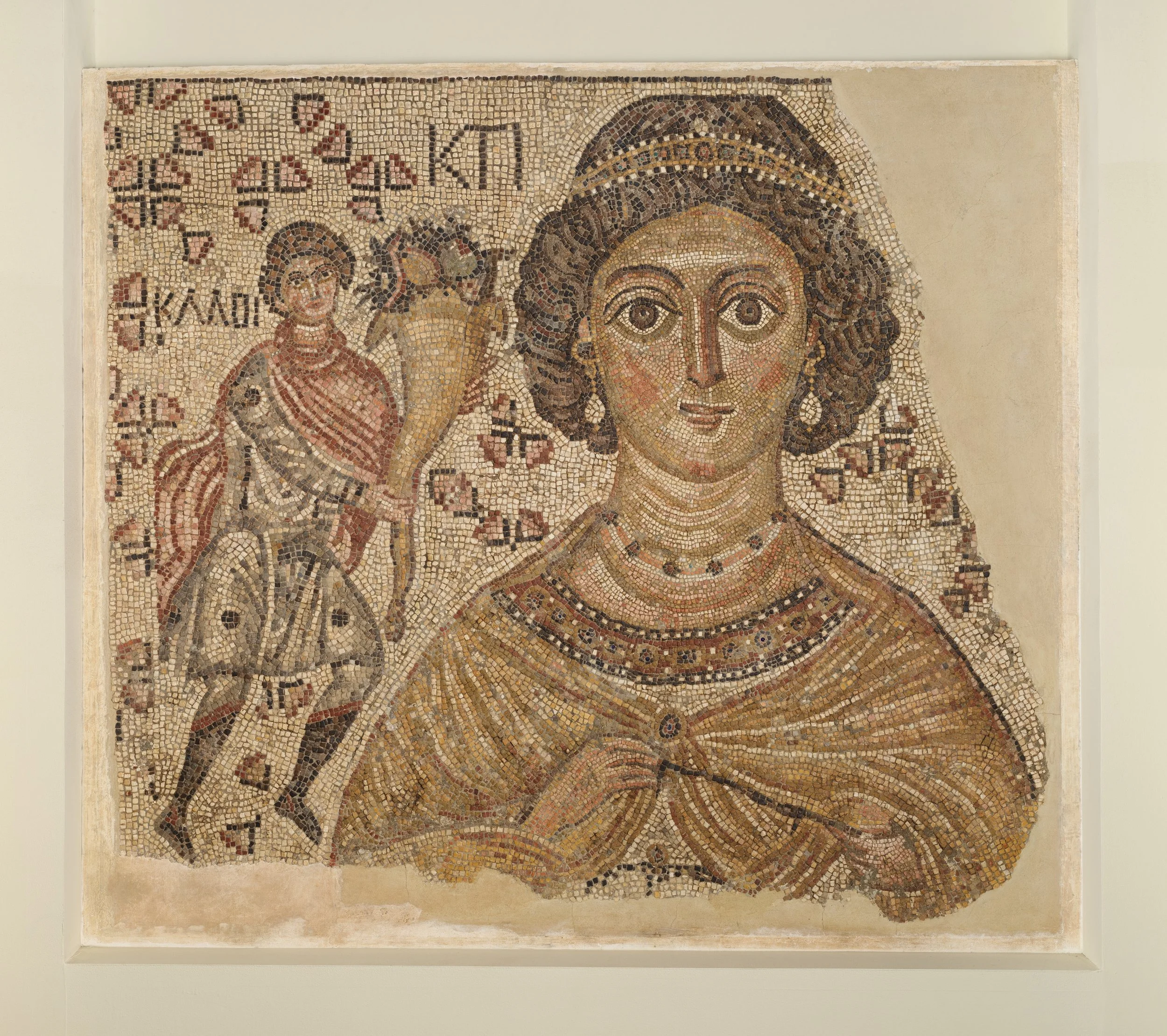
Fragment of a Floor Mosaic with a Personification of Ktisis, 500-550 with modern restoration (1990s), marble and glass tesserae, 59 1/2 x 78 5/8 x 1 in.
Fragment of a Floor Mosaic with a Personification of Ktisis is a mosaic with a personified representation of Ktisis, identifiable by the Greek inscription to the left of her and the measuring tool for the Roman foot in her grasp. Ktisis is a figural representation of generous donation and the act of building. These representations of Ktisis are often found in churches, bathhouses, or other large, often public, buildings. To the left of the bust-length woman, a man holds a cornucopia filled with flowers, which represent abundance. To his left is the Greek inscription “Kaloi”, which translates to “good” or “beautiful”. The location of this mosaic is important to the understanding of what this mosaic represents. Ktisis stands for not only the generous act of donation, but also for foundation. Without a solid foundation, a building will collapse.
Personification of Ktisis, Antioch, found in the House of Ge (Gaia) in Antakya, Türkiye, is a floor mosaic with repeating geometric forms that frame Ktisis. This personification of Ktisis does not seem to be holding the measuring tool for the Roman foot, but is labeled with KTICIC, as is Fragment of a Floor Mosaic with a Personification of Ktisis. This label, paired with the fine earrings, diadem, and garment the figure is wearing, designates this figure as a personification of Ktisis. This mosaic has not been separated from its place of origin. Because this mosaic has not been moved, it is an excellent example of how these personifications would have been interacted with. The fine jewelry this figural representation of Ktisis is wearing, which is made to emulate expensive materials like pearls, gold, and various gemstones.
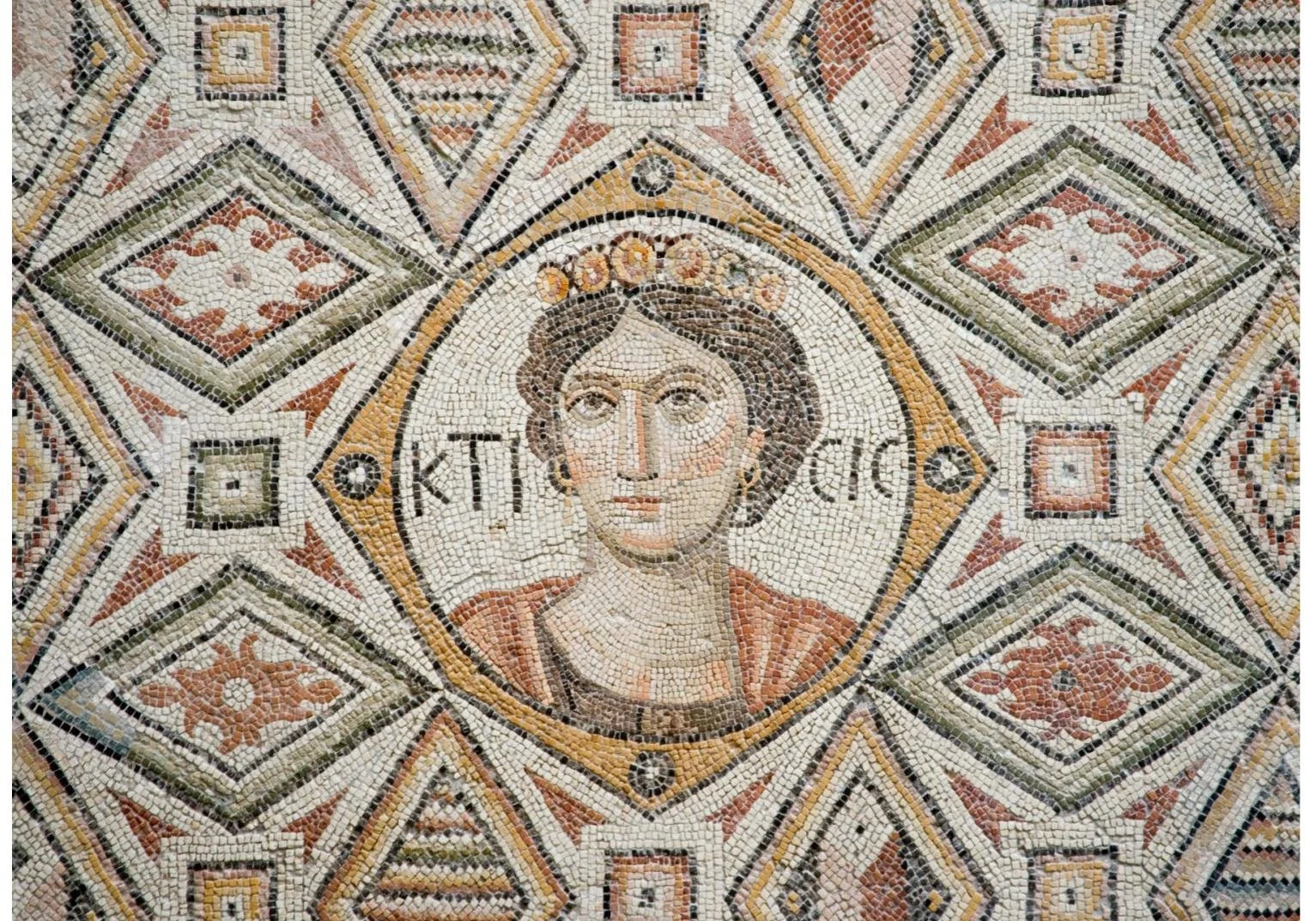
Personification of Ktisis, Antioch, 5th Century, marble and glass tesserae
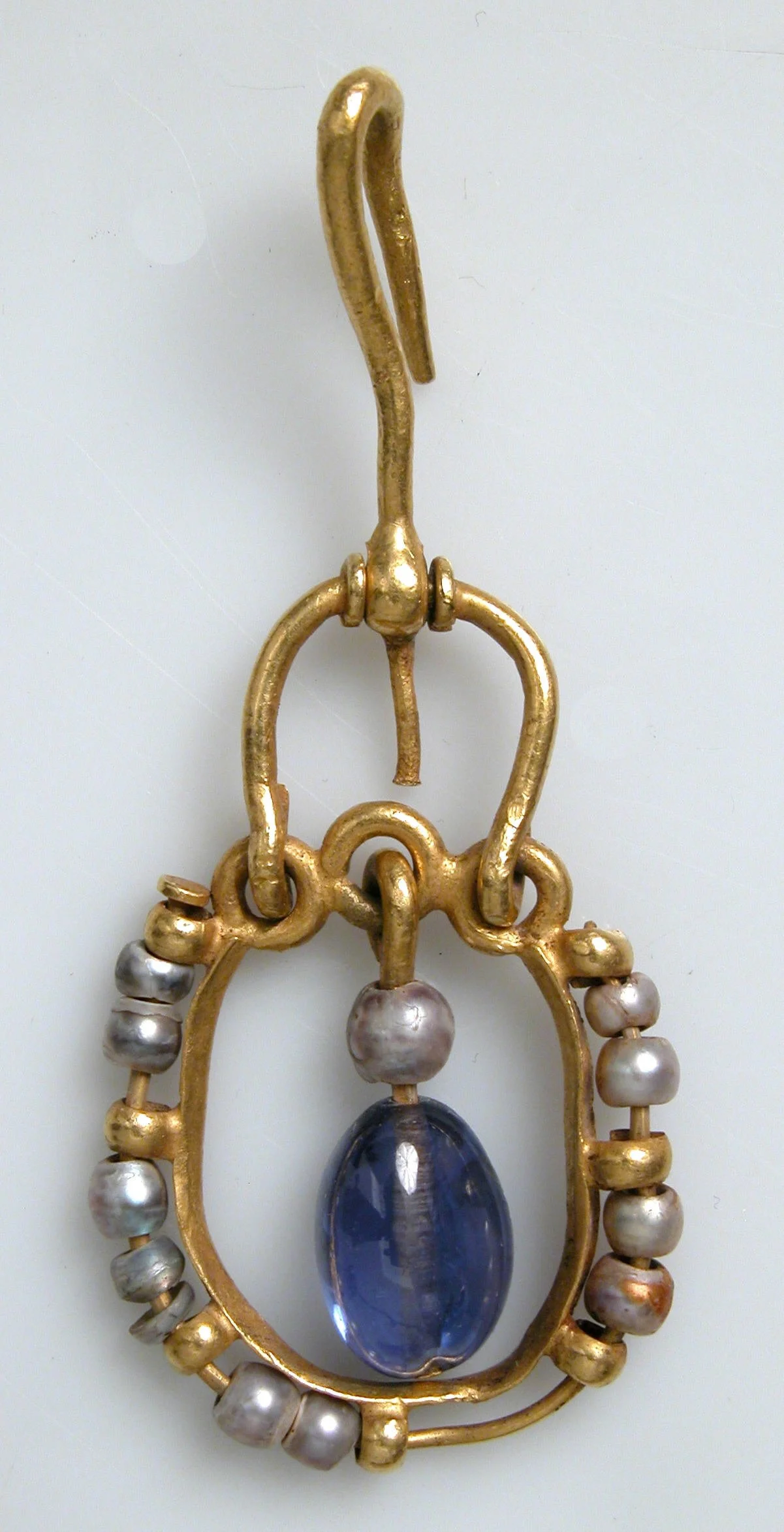
Gold Earring with Pearls and Sapphires, 6th-7th century, gold, pearls, sapphires, 2 3/8 x 1 x 3/8 in.
Gold Earring with Pearls and Sapphires, found at Karavas, Cyprus, and now on view at The Metropolitan Museum of Art, shares visual qualities with the earrings that personifications of Ktisis are depicted wearing. This earring is made of expensive materials and would likely have been worn by a woman belonging to the upper, or even Imperial, class. These figural depictions of Ktisis did not exist in a vacuum: they were intentionally made to be identifiable and recognized as wealthy by Byzantine viewers. The artist designing these mosaics depicting personifications of Ktisis would have likely utilized a real reference or, at least, used tesserae in the mosaics that intentionally emulate expensive, sought-after materials of this time period.
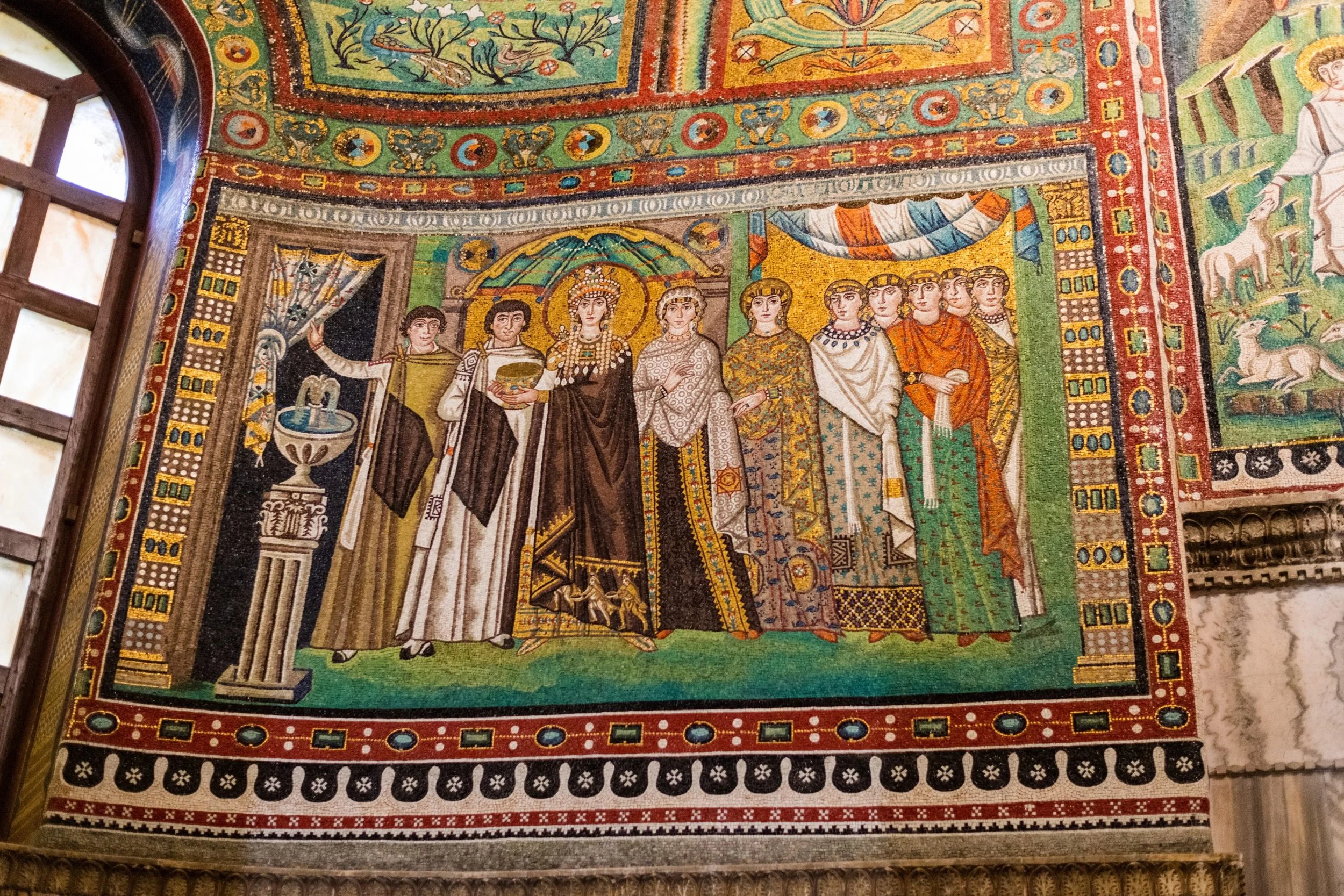
Theodora’s Procession, San Vitale, 540s CE, glass, stone, shell, gold
This mosaic, while not a mosaic depicting a figural personification of Ktisis, is important in contextualizing the wealth displayed in mosaics that depict Ktisis. Theodora’s Procession, found in the Basilica of San Vitale in Ravenna, Italy, differs from the aforementioned mosaics: this mosaic is on the wall, which would be viewed by looking up rather than looking down; the central figure depicted is Empress Theodora, who was a real person and not a figural personification of an abstract concept; Christian iconography, such as the golden halo encircling Theodora’s head, is present; there are several figures; and, finally, this mosaic depicts a scene unfolding in a physical room, while Ktisis is depicted in an ephemeral, nonphysical, space. Despite these differences, there is a commonality between all these mosaics: all of them use visual signifiers of wealth to demonstrate power (whether that be Imperial power or the power of the donation received).
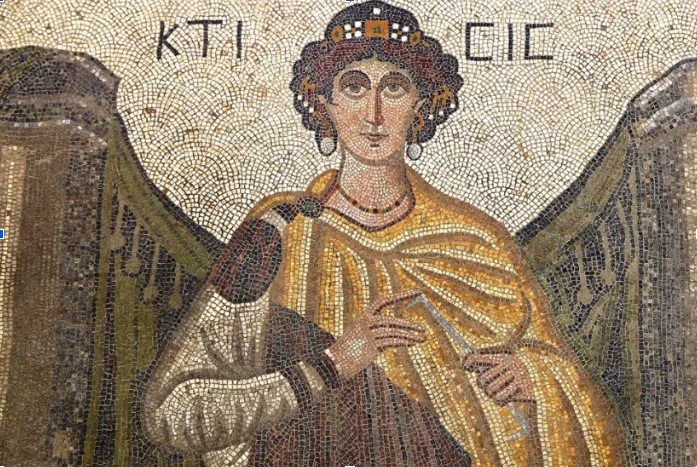
Personification of Ktisis, Urfa, 5th-6th CE, marble and glass tesserae
Personification of Ktisis, Urfa, is exemplary of the commonalities between mosaics of Imperial women and mosaics depicting Ktisis. She is forward-facing; her hair is adorned with a diadem and clips made of gold, gemstones, and pearls; her earrings, dangling down and made of the same materials as the diadem and hair clips; a brightly dyed, yellow garment layered over a white and dark brown tunic; she is labeled KTICIC; and she is holding the symbol intrinsic to her identity: the Roman ruler. Ktisis’ gaze, adornments, garments, and posture are comparable to those in the mosaic Theodora’s Procession, San Vitale. Similar to Theodora’s mosaic, this personification is depicted in a physical space, rather than in an ephemeral one. These mosaics were also made in a similar time period (fifth-sixth century C.E.), meaning these stylistic choices were popular at the time for depicting powerful women with agency comparable to Imperial women.

Mars Rettew (he/they) attended Temple University and majored in Art History. Mars plans to work in Art Restoration or in Museum/Special Collection archives. Their hobbies include chainmailing, jewelry-making, knitting, and crocheting. Mars has a black cat named Armand who was a “foster fail” (they intended on only fostering, but ended up adopting him).