

"The Visual Rhetoric of Innocence: Giotto and the Humanization of Sacred Violence"
Sarah Manherz | Art History 2026
Giotto's The Massacre of the Innocents illustrates an important change from earlier medieval representations of the same biblical theme, especially in its exceptionally human and emotionally powerful representation of infants and young children. The act of violence itself was portrayed more as a symbol of faith than as a physical event in earlier medieval portrayals of the massacre, which often emphasized symbolic order over real-life experience. Figures were realistic, with their expressions muted or uniform. Infants were usually shown as little reproductions of adults, empty of individuality and physical vulnerability, which separated viewers from the event's emotional significance. Giotto, on the other side, introduces an original degree of naturalism that highlights his character's humanity and vulnerability. In his fresco, mothers reacted with pure sadness, hopelessness, and fear, while the infants are clearly young, fragile bodies and physically vulnerable.
This greater realism has significantly affected the viewer's ethical and religious perspective. Giotto creates sympathy and emotional identification by presenting the massacre as a real-life tragedy rather than an abstract story. The artwork creates an important examination of cruelty and injustice as the viewer is forced to face the sorrow of mother loss and the suffering of defenseless bodies. This personal involvement increases the perceived harshness of his decision while also reinforcing Christian moral teachings about compassion and the value of innocent life.
Giotto's approach also reflects broader shifts in the way people thought about the human condition in the early fourteenth century. His attention to emotional expression and physical vulnerability speaks to a growing concern about personal experience and embodied pain. Today, innocence is more than just a religious concept; it is a clearly sensitive and essential human characteristic. In this approach, Giotto changes what viewers think of pain, morality, and the worth of human life while also changing the visual language of religious artwork.
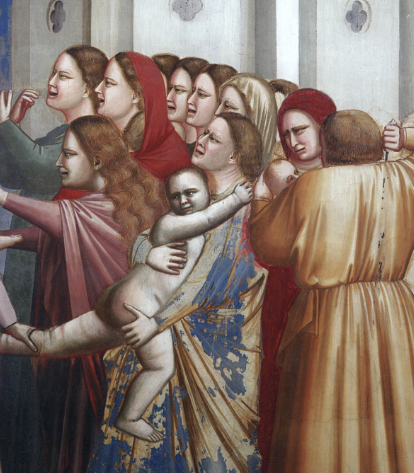
The Massacre of the Innocents (Detail), c. 1305 Fresco Scrovegni Chapel, Padua, Italy
This particular detail from Giotto di Bondone's The Massacre of the Innocents shows the artist's remarkable focus on physical vulnerability and emotional reality. A mother holds her baby securely in the middle, highlighting the child's vulnerability and reliance with its exposed, limp body. The infant's expression, which conveys terror and pain, stands in stark contrast to earlier medieval illustrations where children were often stylized and emotionally neutral. The child's obvious youth in this scene highlights the idea of innocence in the face of violent danger.
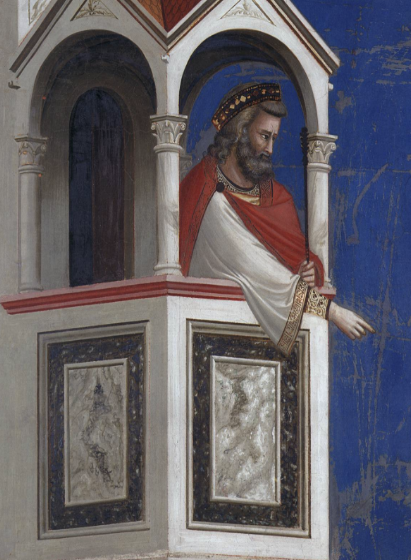
King Herod (Detail from The Massacre of the Innocents), c. 1305 Fresco Scrovegni Chapel, Padua, Italy
This detail emphasizes King Herod as the central figure in The Massacre of the Innocents, whose subtle yet commanding gesture initiates the horrific violence below. His placement within a solid architectural structure emphasizes both his authority and emotional detachment from the unfolding tragedy. Giotto provides Herod psychological depth, which is different from earlier medieval depictions that show rulers as symbolic figures. His downward gaze and pointed hand suggest deliberate intent, making him morally accountable for the suffering of the innocent. Below him, the women occupy convincing physical space, their overlapping forms creating a sense of chaos and urgency. This heightened realism transforms the biblical narrative into a deeply human tragedy, encouraging viewers to empathize with the fear and grief of the mothers. Through expressive gestures and emotional intensity, Giotto underscores themes of innocence, vulnerability, and human suffering.
This moment in The Massacre of the Innocents captures the powerful emotional turmoil experienced by a mother, demonstrating Giotto's break from traditional medieval restraint. With their lowered brows and gaping mouths in agonized cries, the women's faces are uniquely expressive and convey a raw immediacy rare in earlier portrayals of the subject. As they try to shield their kids from invisible violence just outside the frame, their outstretched hands that are tense, spread, and reaching visually communicate desperation.
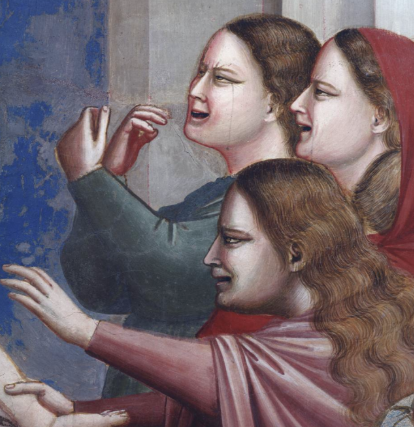
The Weeping Mothers (Detail from The Massacre of the Innocents), c. 1305 Fresco Scrovegni Chapel, Padua, Italy
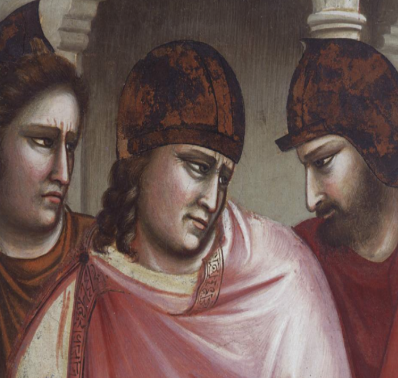
The Soldiers of Herod (Detail from The Massacre of the Innocents), c. 1305 Fresco Scrovegni Chapel, Padua, Italy
This specific detail from Giotto's The Massacre of the Innocents demonstrates an important change from earlier medieval depictions of the subject. Giotto stresses individual faces that reflect sorrow, uncertainty, and moral conflict rather than drawn-out, distant designs. The men portrayed here are psychologically complex actors rather than abstract creators of violence; their furrowed brows and downcast eyes suggest unease or reluctant cooperation. The emotional impact of the larger situation in which infants and children are victims not only symbolically but also physically and vulnerably becomes more acute with this humanization. Giotto's realism encourages viewers to think emotionally and challenges them with the psychological consequences of cruelty, in contrast to earlier, more stern expressions. This method promotes the study of suffering and innocence by transforming the story into a moral experience. Giotto's emphasis on emotional reality is consistent with the standards of the fourteenth century, which emphasize lived experience and render religious stories more relevant, immediate, and morally compelling.

Over the past few years, I have been exploring the path that best aligns with my passions and goals. I initially pursued art history because of my deep appreciation for art and its historical significance. However, after taking courses in psychology, I discovered a strong interest in supporting others and began to shift my focus toward becoming a school counselor. I hope to combine my background in art with counseling by using creative expression as a tool to help children communicate, grow, and thrive. My goal is to make a meaningful impact in students' lives through both emotional support and creativity.
Instagram: @sarah_mannherz