What is it?: Proletarian Photographic Arts and Propaganda in the Soviet Union and Japan
Alexis Rago | Art History 2026
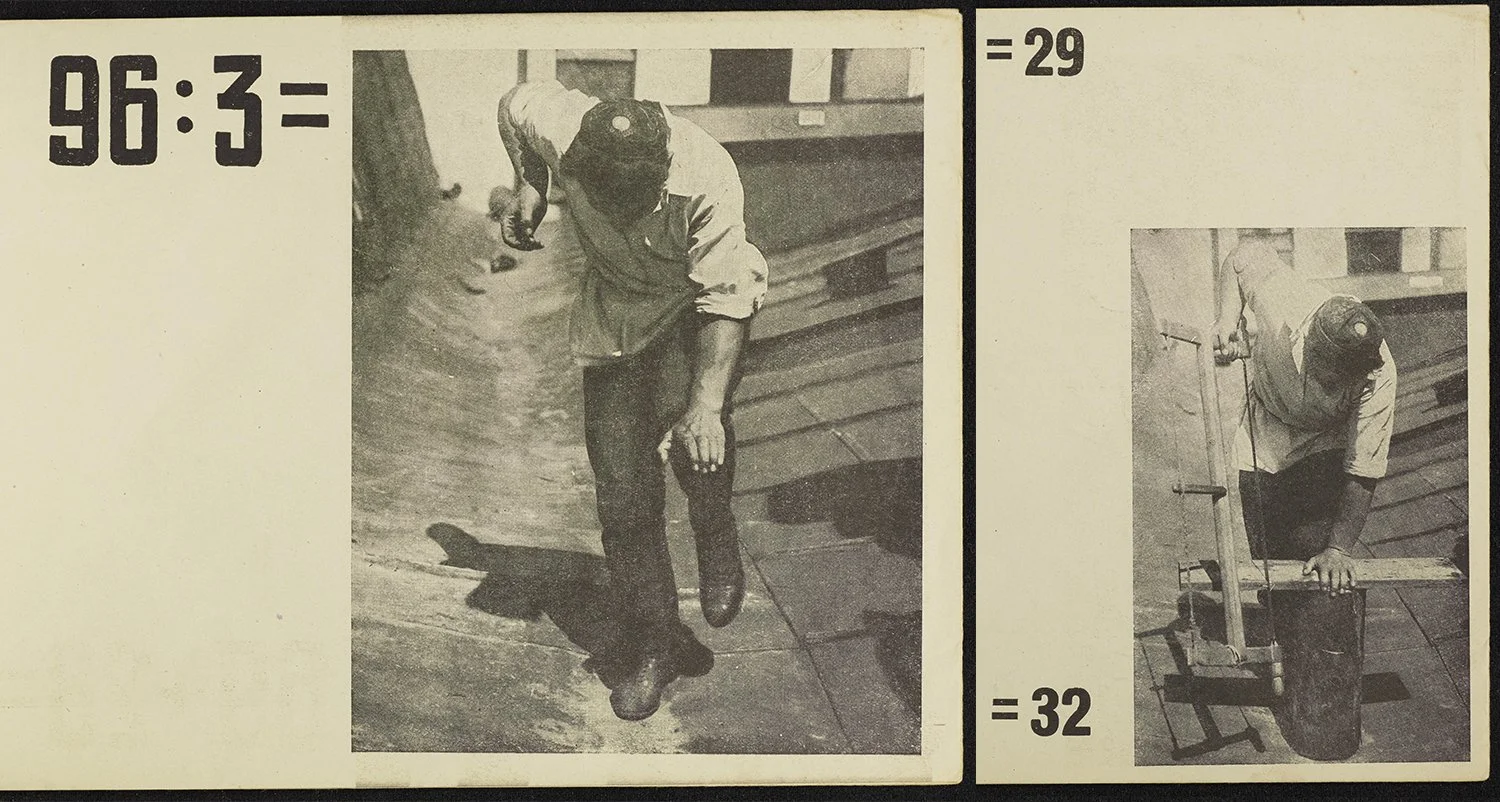
Vladimir Griuntal and Grigoriy Iablonovskiy. Chto eto takoe? (What is it?), 1932. Moscow: OGIZ Molodaia Gvardiia | Princeton University Library. Left: “Question” page. Right: detail of “Answer” page
Chto eto takoe? (What is it?) was a children’s book published in Moscow in 1932 consisting of simple math problems arranged around photos of everyday objects and activities framed to make them appear alien. This method is indicative of a larger trend in art that illustrates the vision of Viktor Shklovsky, who described it as ostranenie, or defamiliarization, in 1917. He wrote that defamiliarizing art affects us by allowing us to perceive familiar things as if they are novel since we do not recognize them.
In the years following the Bolshevik revolution, the rise of Socialism in the Soviet Union led to a surge in proletarian art focusing on the working-class, which took hold in Japan at about the same time. The MAVO movement incorporated leftist political thought, seeking to eliminate the separation between art and daily life. In the face of a national push for industrialization and “modernity” not unlike that in the Soviet Union, MAVO artists expressed anarchist and anti-establishment sentiments, as well as dada-like commentary through sculpture and collage incorporating photography. Building on basic MAVO concepts, Shinkō Shashin, or New Photography, describes a subsequent era of Japanese photography where photographers embraced defamiliarizing methods, creating modern portrayals of the country’s westernization via common subjects.
Photographers in both nations embraced the departure from pictorialism and the influence of proletarian art, manifesting through designs and montages published in photo magazines. Soviet artists like El Lissitzky, Aleksander Rodchenko, and Varvara Stepanova popularized the medium of photomontage in this socio-political context. The ability to create idealistic visions using photography’s inherent link to real life made it perfect to apply to propaganda. Japanese propagandists, some of whom were players in the development of New Photography, borrowed these ideas, combining the Japanese photographic style with the Soviet/German photomontage medium to produce their own propaganda.
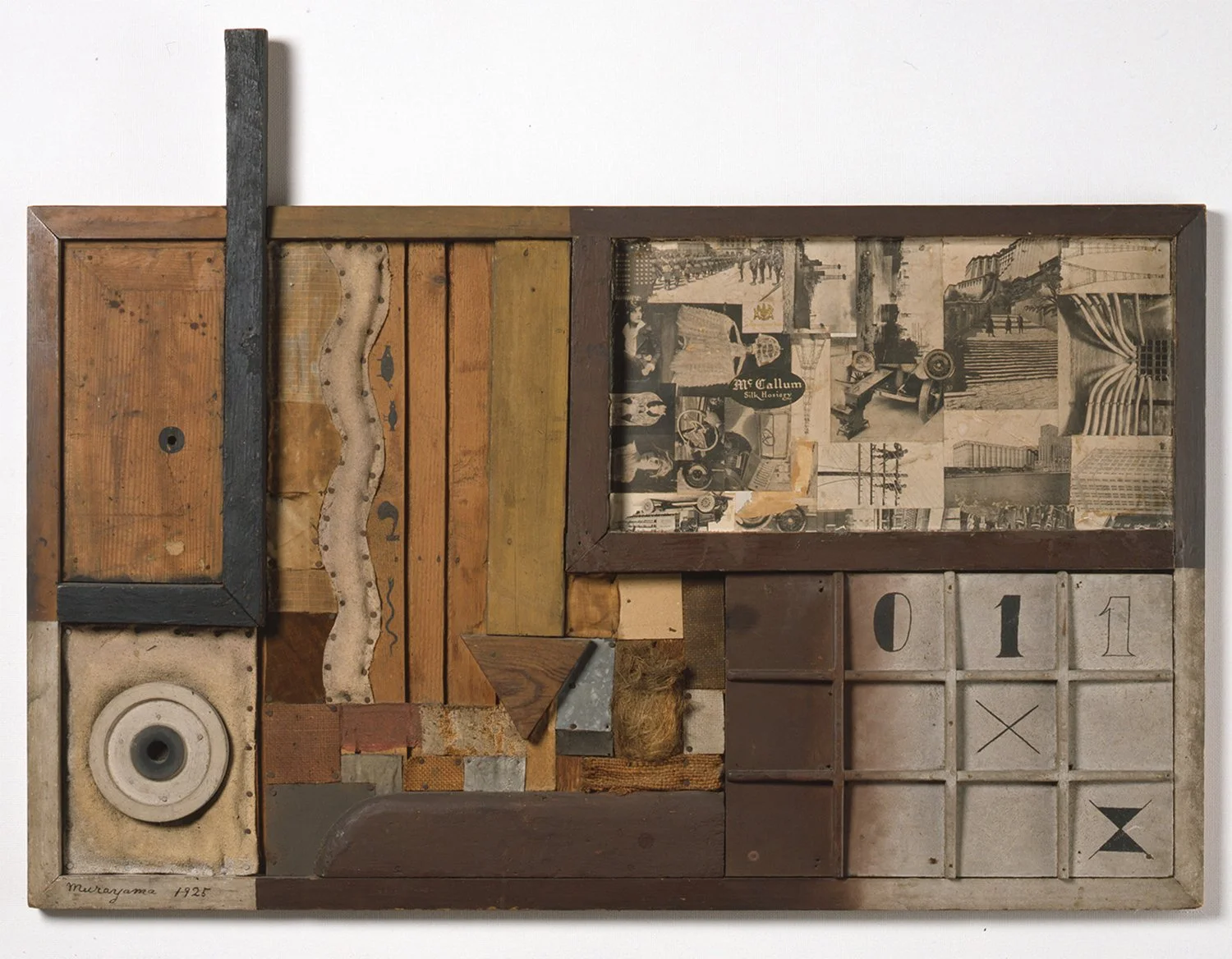
Murayama Tomoyoshi, Construction (Konsutorukuchon), 1925, mixed media (oil, paper, wood, cloth, metal, leather, etc.), 33 1/8 x 44 3/16 inches | Tokyo National Museum of Modern Art.
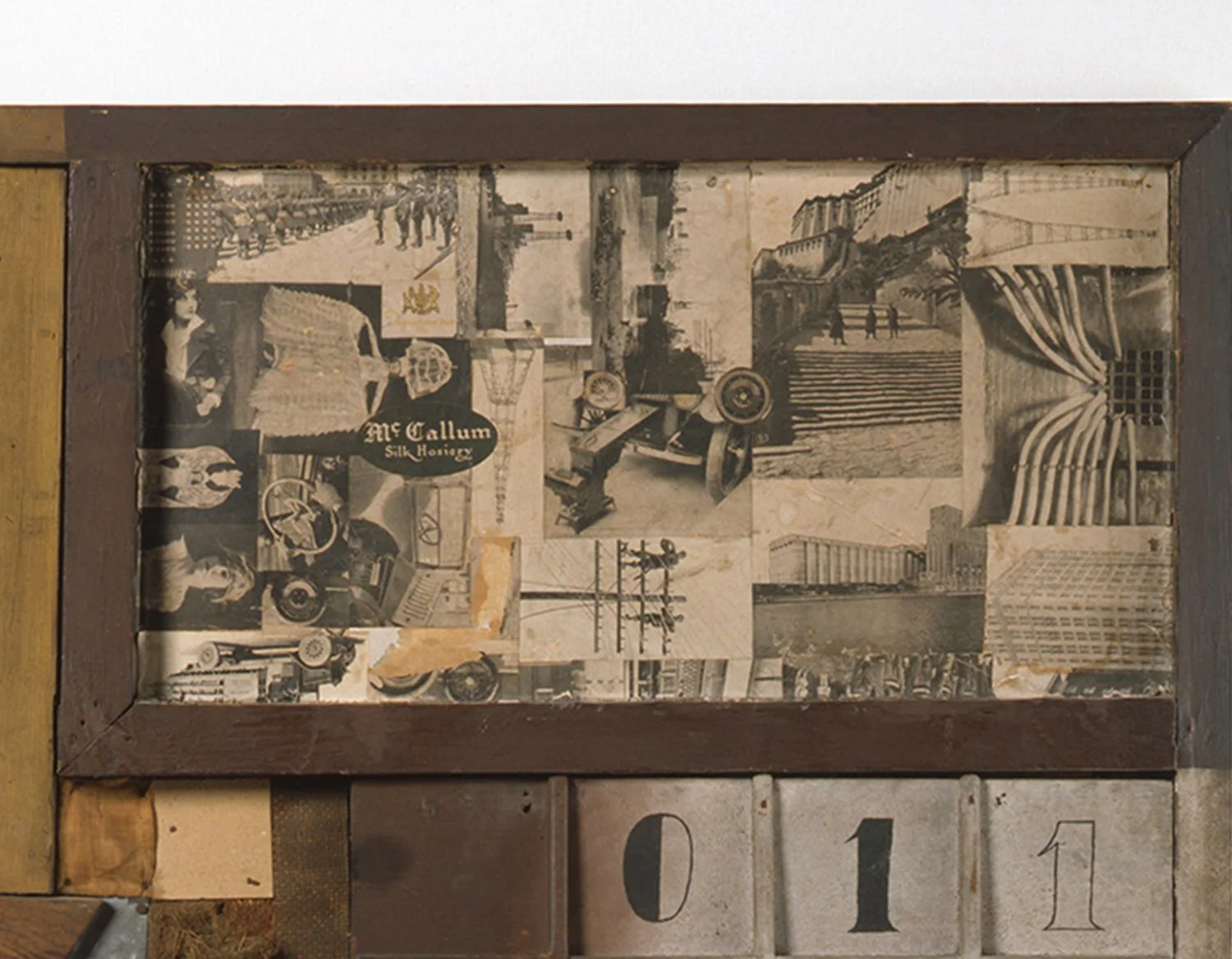
Murayama Tomoyoshi, Detail of Construction (Konsutorukuchon), 1925, mixed media (oil, paper, wood, cloth, metal, leather, etc.).
Murayama Tomoyoshi was the leader of the MAVO movement and editor of its magazine. Having studied in Germany, he was a key figure in relaying Futurism, Dadaism, and Constructivism to Japan. His sculptural piece, Construction, features a photo collage demonstrating the social and political ideas of the MAVO movement. The photographs picture industrial and electrical infrastructure, workers and soldiers, wheels of vehicles, and women in Broadway costume. This variety contributes to the piece’s “conscious constructivism,” a concept Murayama introduced which dictated an expansion of art’s subject matter to portray “the entirety of life” and the full range of human emotions. Through rotating, cropping, and obscuring the photos, the collage creates a jumbled, complex impression of life, not particular to any one location. Staying loyal to the subject of daily life, the ability to connect to the imagery based on class rather than nationality reinforces the proletarian politics in Murayama’s philosophy.
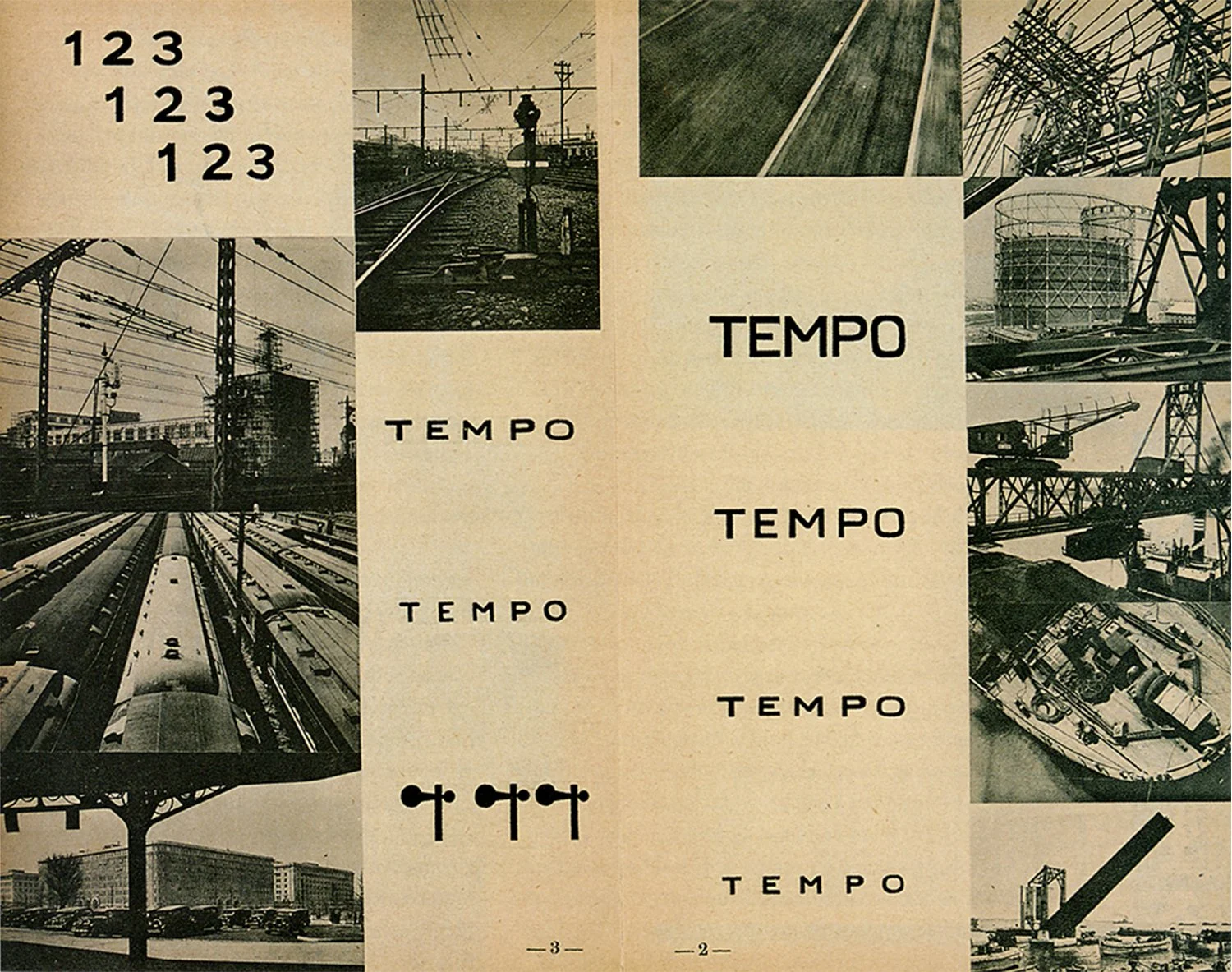
Horino Masao and Itakgaki Takao. Dai Tokyo no Seikaku (The Character of Greater Tokyo), in Chuokoron Vol. 46, no. 10, 1931. Tokyo: Chuokoronsha.
Horino Masao was one of the most prominent photographers in the development of Japanese New Photography. He contributed to the foundational photo magazines of the movement, including Kōga, Photo Times, Shinkō Shashin Kenkyū (New Photography Studies), and more. Horino’s style of framing and composing rejects pictorialism and experiments with composition, montage, and text not unlike What is it or Construction. In The Character of Greater Tokyo, he uses this defamiliarizing photographic style to document the rebuilding of Tokyo after the Great Kantō Earthquake, resulting in similarly progressive futurist visual language.
At the time, Horino was working with photomontage inspired by that of Soviet artists, similarly depicting common people, industry, and sports. However, in multiple series taken in Korea and Taiwan such as Chōsen no inshō (Impressions of Korea), his work evolved into tourism propaganda. He published romanticized photographs falsely suggesting that his subjects were prospering under Japanese imperial policies.
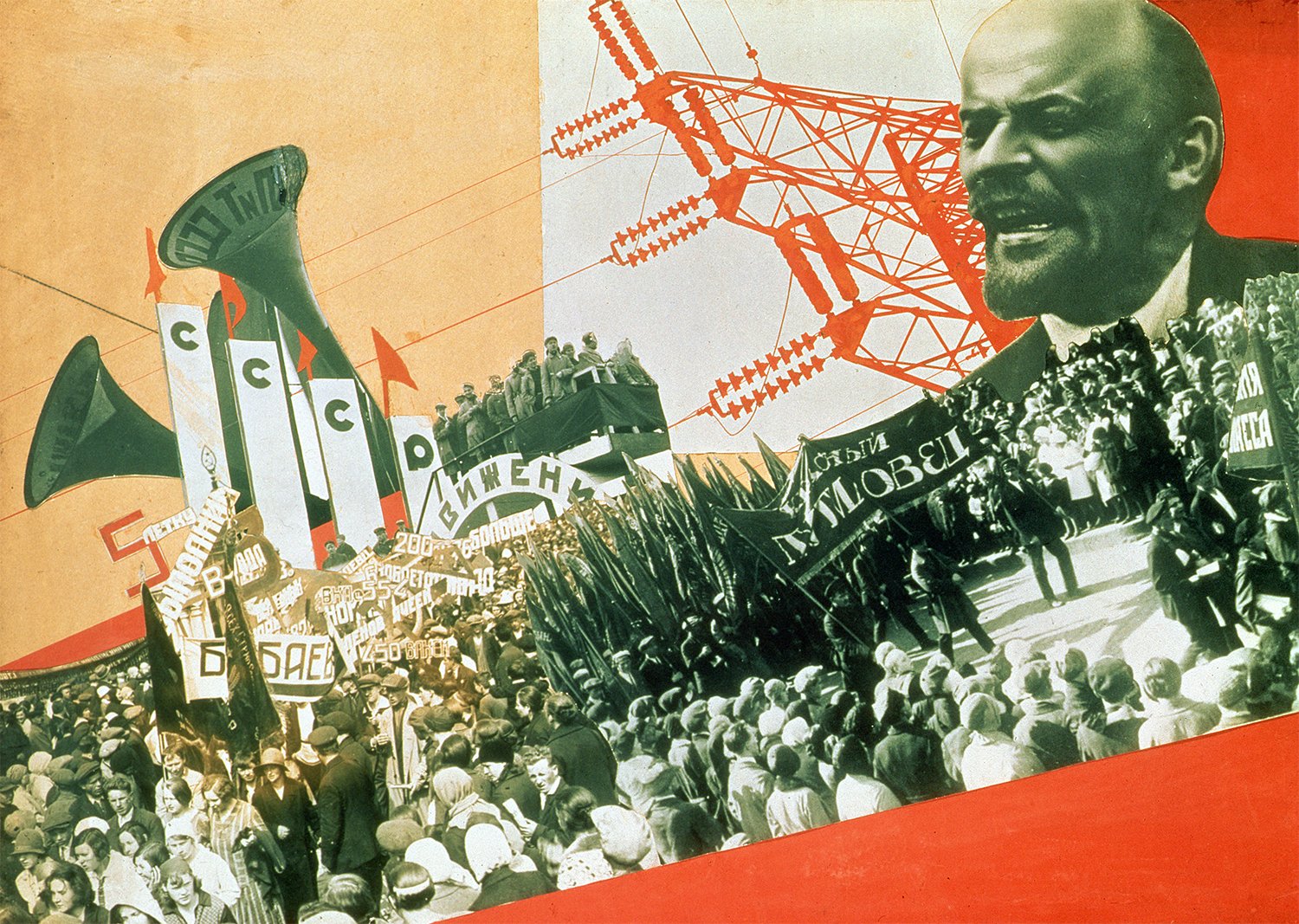
Varvara Stepanova, The Results of the First Five-Year Plan, 1932, photomontage | State Museum of Contemporary Russian History.
Varvara Stepanova was one of the most prominent Soviet artists using photomontage, and identified as a constructivist. This piece, The Results of the First Five-Year Plan, reflects on the supposed success of Stalin’s Five-Year Plan, initiated in 1928. Though economists are said to have inflated impact of the plan on the Soviet economy, artists contributed to its framing as a success. Stepanova’s creative use of photomontage resulted in a compelling vision of Soviet and socialist prosperity; the vivid blocks of red, bold initials for USSR, and masses of celebratory supporters are skewed to suggest an upward trajectory for the proletariat.
Stepanova and her husband, Rodchenko, were also designers of the propaganda magazine SSSR na Stroike (USSR in Construction), which reached international audiences. Spreads from the magazine similarly conveyed Soviet prosperity, highlighting industry and military. Soviet photomontage served as a model not only for other proletariat populations but aspiring propagandists.
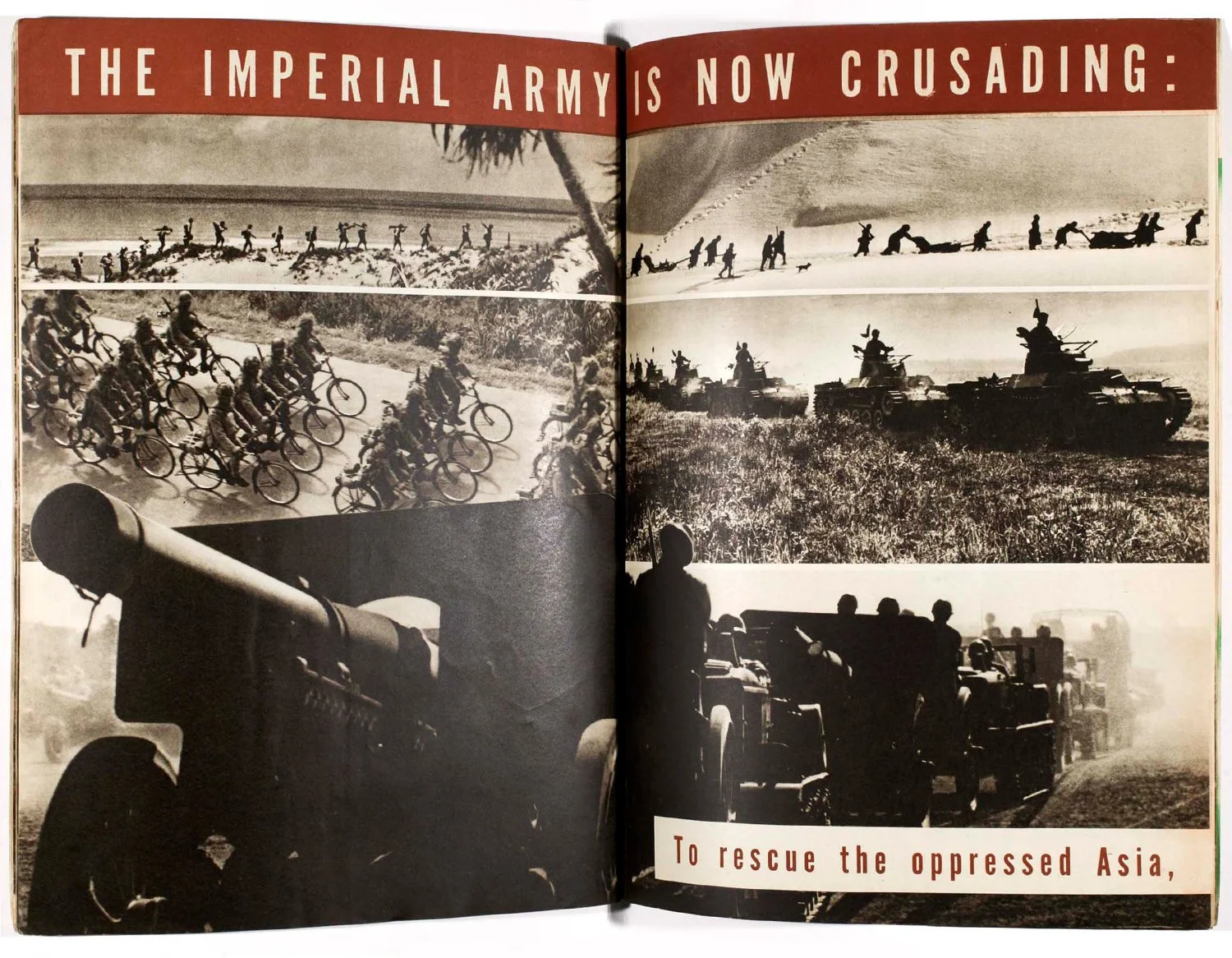
Hara Hiromu, Hiroshi Hamaya, Kimura Ihei, and Okada Sōzō. Spread in FRONT nos. 3 & 4 (English version), 1942. Tokyo: Tōhōsha.
The Japanese propaganda magazine FRONT was modeled directly after USSR in Construction, though, sponsorship from the military resulted in a more prominent imperial theme. The main contributors to FRONT came from New Photography or transnational leftist backgrounds, coming together to produce propaganda informed by larger modernist artistic movements.
Hiroshi Hamaya and Kimura Ihei were renowned modern photographers, the latter a major contributor to Kōga. Hara Hiromu, FRONT’s designer, had previously worked with Murayama, László Moholy-Nagy, and El Lissitzky. Okada Sōzō, FRONT’s editor, was also interested in leftist politics and arts, having been to both Moscow and Germany. The team, working under the name Tōhōsha (Far East Company), combined international proletarian arts, modern Japanese photography, and the country’s imperialist military agenda. The role that photography played in this publication mirrors that in Soviet photomontage: it uses its link to reality to normalize propagandistic messages, heightened by creative artistic approaches to design.

Alexis is an art history major/history minor graduating in the spring of 2026. She also received an associate's degree in art and art history from Bucks County Community College in 2024. Alexis’ interests span across the history of art, but she often focuses on modern art from the mid-19th to the mid-20th century. In her own art practice, her preferred mediums to work with are dry media, digital, and photography. Alexis is currently working part-time at The Print Center, a nonprofit gallery for photography and printmaking.