

WW1: To See or Not To See
Emma Vanderbilt | Art History 2026
World War One was a war unlike any before it. Technology and industrialization was something never seen before and military leaders were not prepared for these and had trouble adapting, still using outdated strategy. On land soldiers had to run through muddy no man’s land from trenches, facing rifles, bayonets, grenades, mustard gas, and pistols. Airplanes were a new addition to war and eventually engineered to be more dangerous and armed with machine guns, allowing for air fights referred to as dogfights. Eventually they were able to carry bombs, devastating cities and civilians. In the water submarines were developing underwater explosives and listening devices. Above the water war ships now had radios making communication more effective.
Both people on the front lines and families at home were mentally and physically changed forever after witnessing the mass destruction the war caused. Some of these advancements were cultivated by artists and art, which played a big part in combating the new issues that arose. The use of camouflage as we know it was implemented and unorthodox ideas were used to deter enemy weaponry. Even post-war artists along with organizations like the American Red Cross brought some sense of normalcy to wounded soldiers by making prosthesis. This section(?) will in more detail to explore the connections of this theme of concealing war and its effects. Doing so by highlighting specific examples and people involved. Bringing to light the once concealed and part of history that has gotten lost amongst the destruction the war left behind.
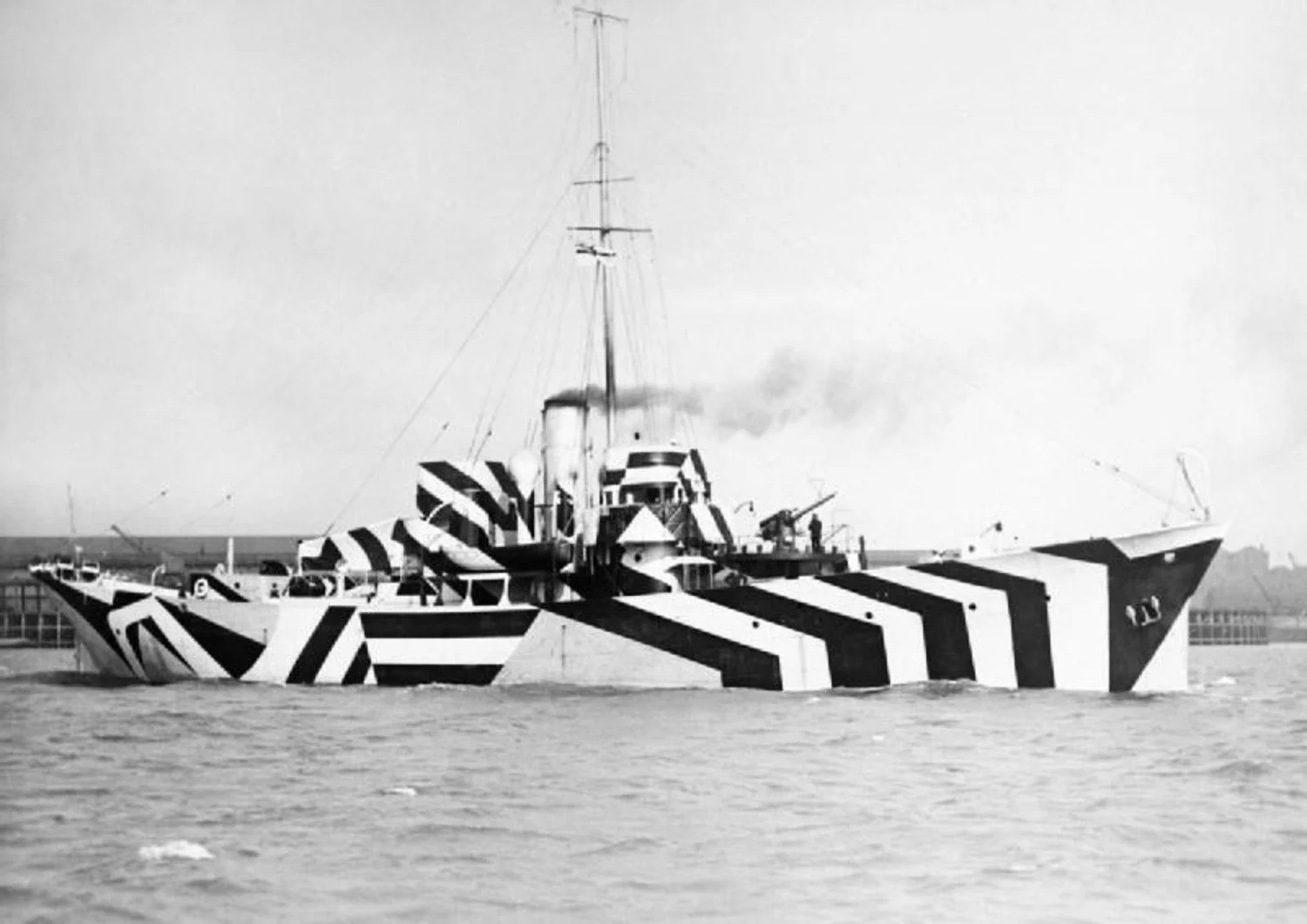
Photograph of British Kil class patrol gunboat HMS Kildangan painted in dazzle camouflage. The collections of the Imperial War Museums via Wikicommons German U-boats or (or Unterseeboots) were doing great damage to the British naval force in the later parts of the war. Torpedoes from the Germans were making the Allied powers worried and German policy became unrestricted in 1917, which allowed for any boat (merchant included) within the war zone to get attacked. This was a result of mimicry camouflage the British used that created Q-ships, which were ships disguised as merchant ships making their identity customizable.
The same year British illustrator Norman Wilkinson decided that the camouflage used for boats was ineffective as it was made for the ground. He came up with the idea that ships should be painted with irregular patterns, making the gunner on the U-Boats unable to tell the ships course, size, speed and distance, “Dazzling” the Germans and creating what is now Dazzle Camouflage.
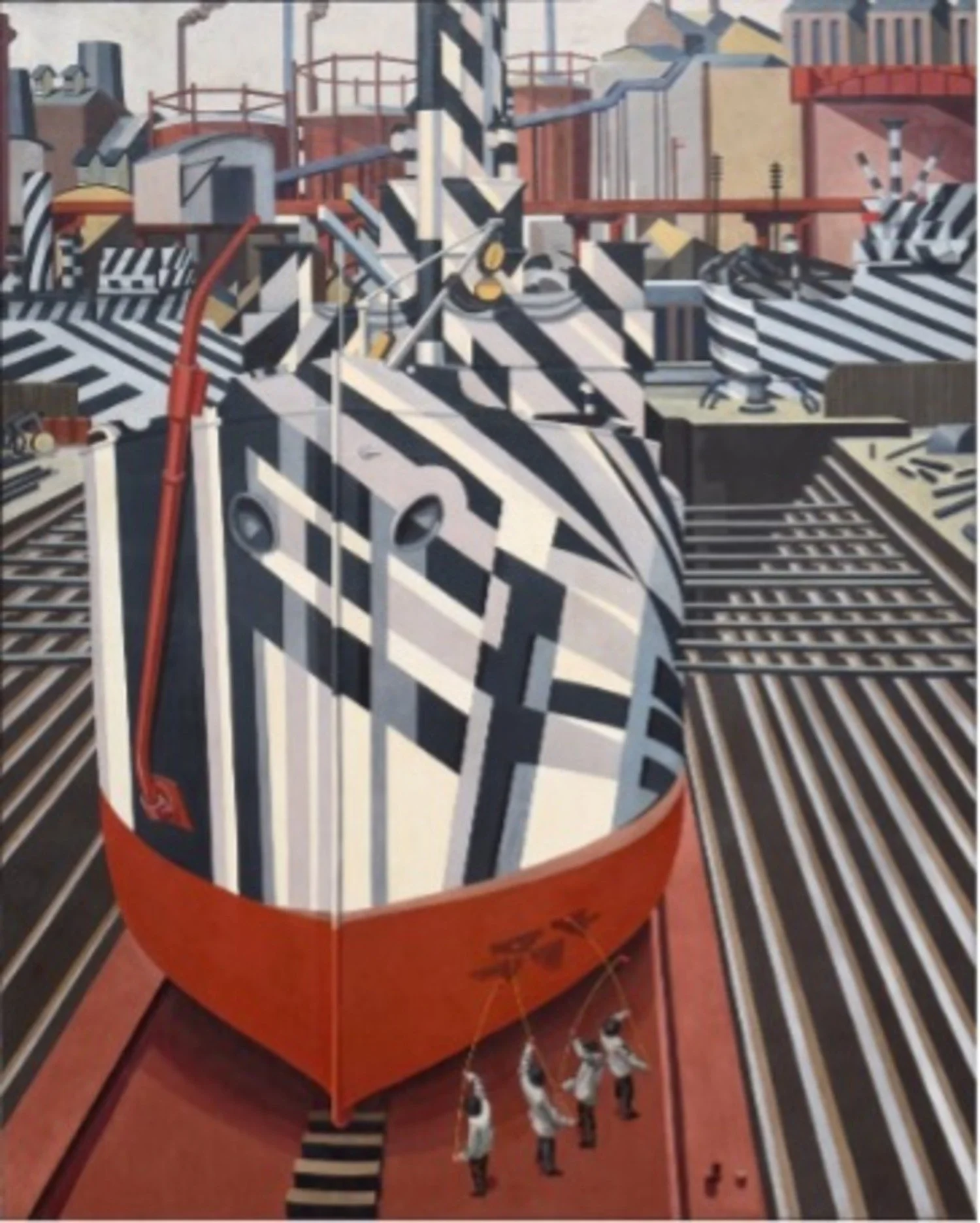
Edward Wadsworth, Dazzle-ships in Drydock at Liverpool 1919. Oil on canvas, 304. 8 x 243.8 mm. © Estate of Edward Wadsworth. All rights reserved, DACS 2015. Photo courtesy National Art Gallery of Canada.
The visual components went on to inspire the more conventional artists after the war, including British artists Edward Wadsworth. Born in 1889 to a wealthy family of textile manufactures while he went to school to follow in his father’s footsteps, he also attended the Knirr Art School studying multi-disciplinary art practices. Thrown in to the art world at the creation and popularization of a multitude of modernist movements, eventually joining the short-lived
Vorticism movement, which called for complete abstraction through a vortex form in 1914. But soon got swept into fighting the war the very next year joining the Royal Navy Volunteer Reserve and eventually going to the Eastern Mediterranean. This painting mixes his experience in the war watching ships like this in the Navy with his modernist, vortistic style using dazzle painted ships as subject maker.
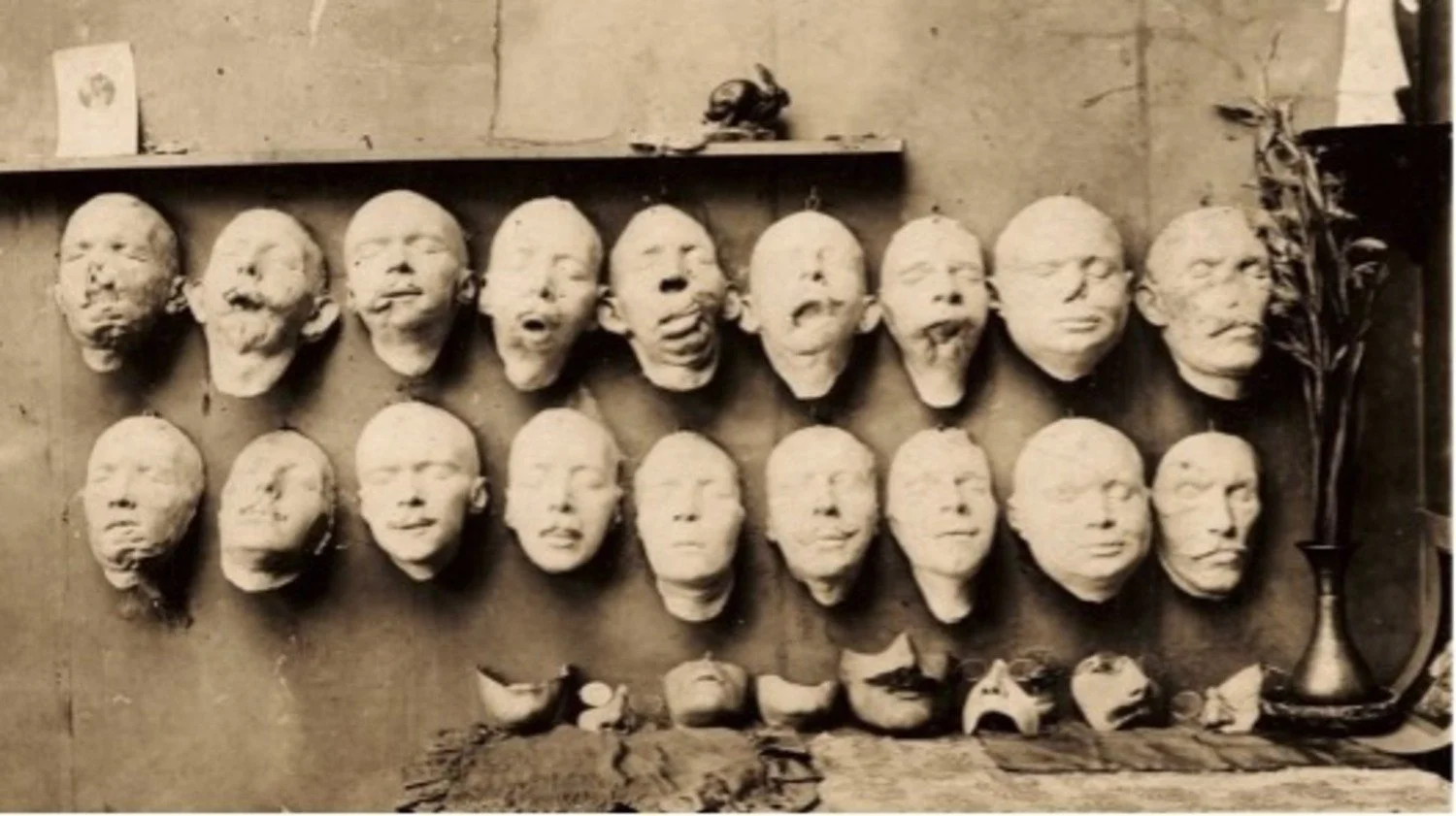
Casts of injured men’s faces in Anna Coleman Ladd’s studio c.1917. Image from the Anna Coleman Ladd’s Archive, Archive of American Art, Smithsonian.
Advances in technology made for the creation of motorized ambulances which allowed for many more soldiers to live but led many permanently disabled and disfigured if they survived the battlefield, American artist Anna Coleman Ladd did the important work in making -n masks, giving the wounded normalcy. This is an image from Anna Coleman Ladds studio in France. Ladd was an American artist from Boston, Massachusetts. Ladd (born Anna Coleman Watts) was raised in Paris has a background as a sculptor and portrait artist. She studied sculpture in Rome before marrying pediatrician Maynerd Ladd in 1905. During the war she moved to France and worked with the Red Cross making prosthetics, creating the American Red Cross for Portrait Masks for Mutilated Soldiers. In a way camouflage followed the soldiers home as a way to cope with living post war.
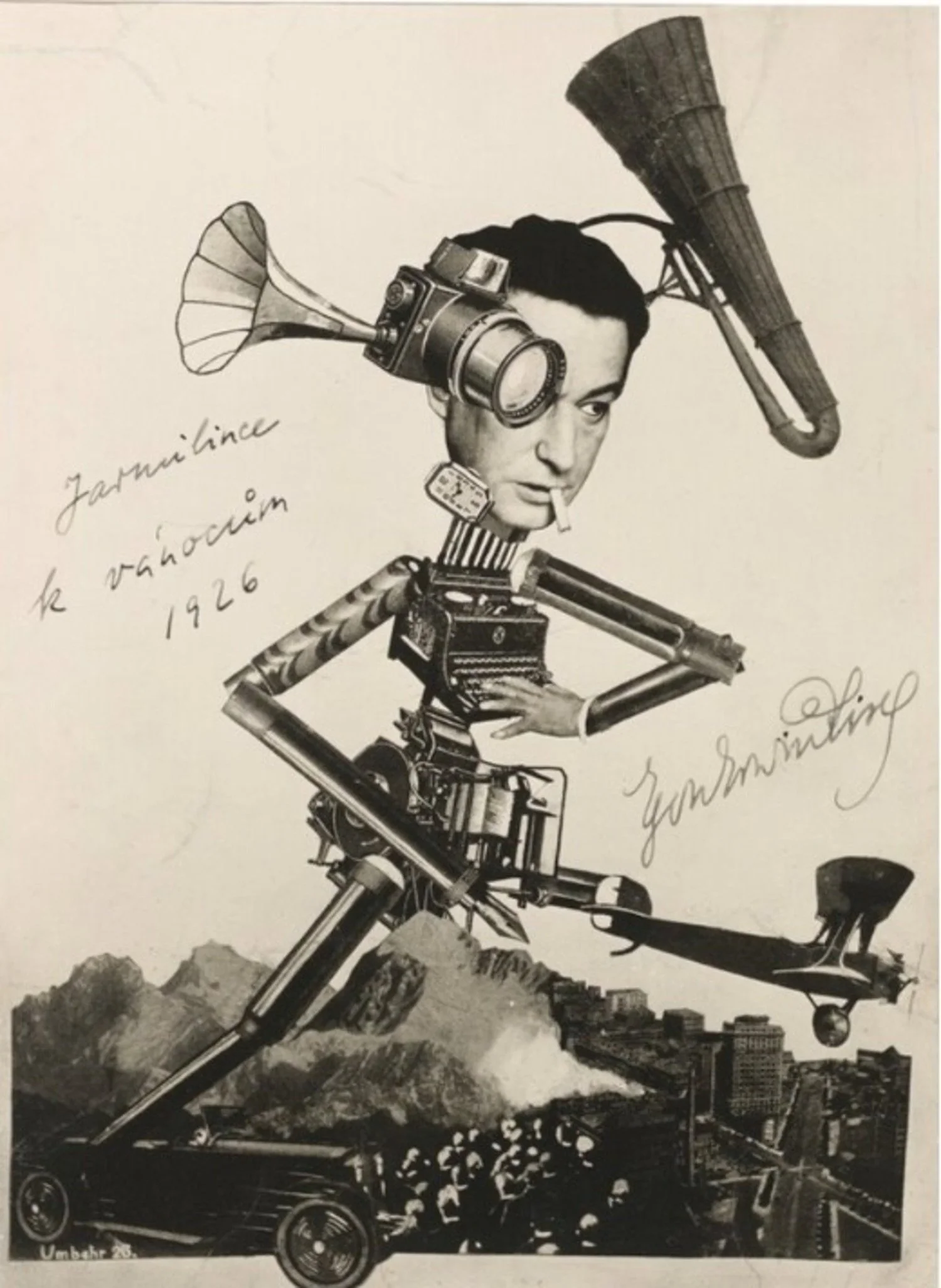
Der Rasende Reporter (The Racing Reporter) (Egon Erwin Kisch), OOo Umbehr,1926, gela-n silver print of photomontage, Na-onal Gallery of Art , 2006.61.1
The print comes from Weimar Germany specifically and depicts real Austro-Hungarian journalist Egon Erwin Kisch as a bionic human. His limbs being tools to work with like a type writer and pen.
After the war the further innovation of both facial prosthetics and practical prosthetics made for limbs captivated the people of Weimar Germany people with prosthetics became somewhat of an icon and appeared in many facets of popular culture like literature and movies. Artists and creatives began to show interest in the idea of a bionic human. This new body that is modern machine and organic maker that can deal with the new challenges of an industrial era. This eventually lead to interest in the fully artificial from head to toe and eventually films like Metropolis (1927) that featured a robot woman.
Emma Vanderbilt is a senior at Temple University majoring in Art History with a minor in Screen Studies. She fell in love with art after going to the Allentown Art Museum as a child and wants to pursue a career in Museum Education. In her free time, she loves buying trinkets and mystery boxes.