

"Witnessing Goya": The Correlation Between His Art and Health Throughout His Career
Olivia Cooper | Art History 2026
Francisco Goya was one of the greatest portrait artists of the Romanticism and Rococo era in Spain. Goya fell ill and spent the next five years recuperating from his illness, which caused him to go deaf. He was scarred from the possibility of going blind and losing his mobility from the illness as well. He began hallucinating, losing his balance and general weakness. His life changed dramatically after this illness. He was active, popular in the public, and painting successful commissions. He was now isolated from that former life and deaf. He was left with his own inner, dark images. In addition to his illness, Goya experienced a lot of other traumas, from occupation, war, famine, death and murder; Goya had witnessed it all and his art documented it. As evident in the images below, I aim to show the mental decline in Goya and how it is expressed through his artworks. For this paper, I chose images from Goya’s earlier days, when he was commissioned by the elite in society and how over time, due to traumatic events and physical illness, Goya’s work became very dark. Despite his physical and mental anguish, Goya continued to make art, which was driven by emotions. This project aims to examine various works by Goya and show the change in his artwork and how it was impacted by his declining health, and how over time these inner thoughts and emotions merged into his artwork.
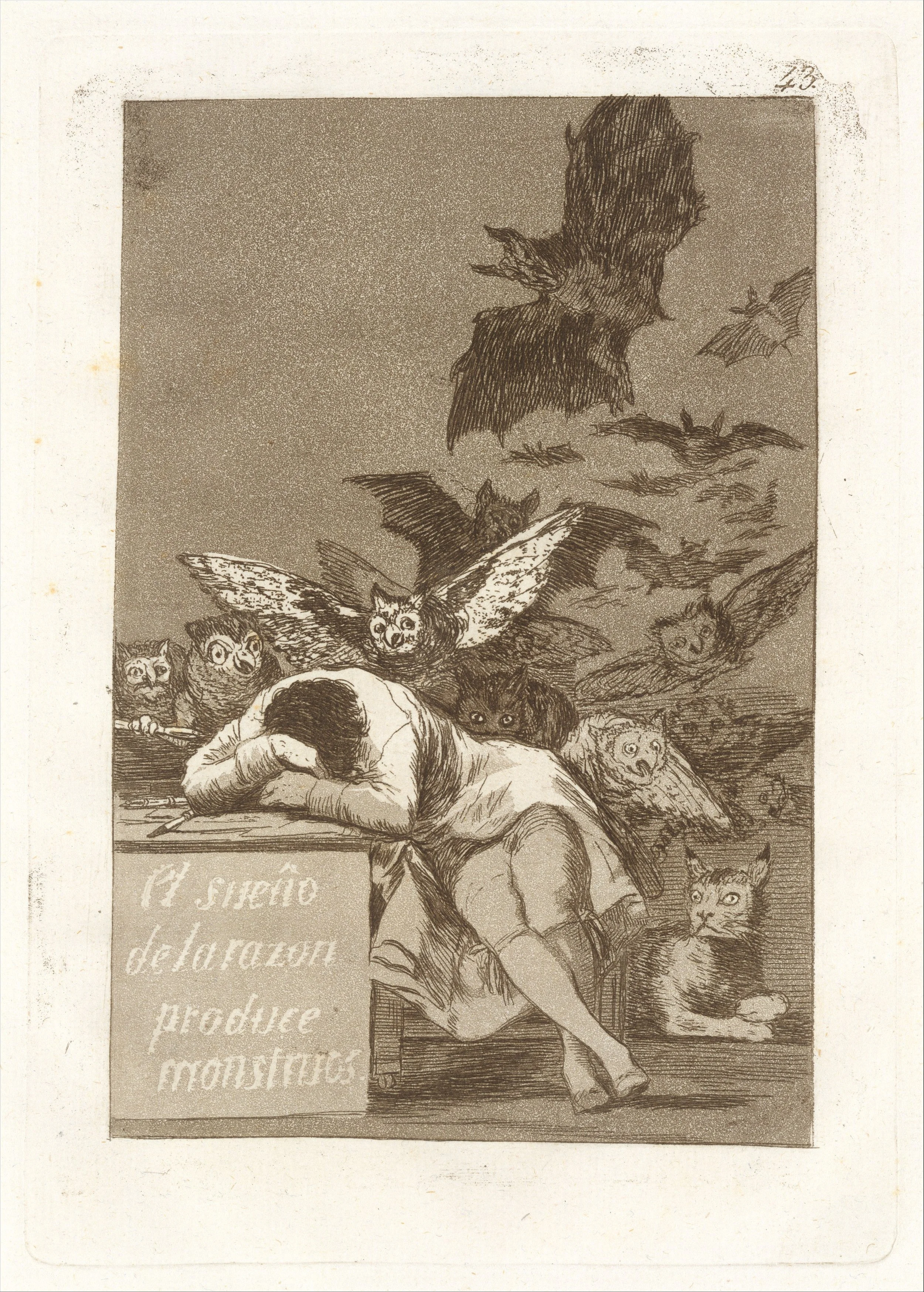
Goya (Francisco de Goya y Lucientes) 1799 Prints Plate: 8 3/8 x 5 15/16 in. (21.2 x 15.1 cm)Sheet: 11 5/8 x 8 1/4 in. (29.5 x 21 cm)
“The Sleep of Reason Produces Monsters” is an etching from the “Los Caprichos” an 80 print series published in 1799 centering round Goya’s criticism of the society in which he lived. This piece shows a sleeping man seemingly referring to Goya. He is surrounded by Goya's grotesque visions that surround from the sleeper's head. A lynx, cats, and owls eyes wide open, stares into the foreground awakening a sense of vigilance. Goya had spent five years recuperating from several illnesses that left: him deaf suffered hallucinatory fevers, loss of balance, and overall weakness and was traumatized from the fear that he could have lost his sight and his mobility. His previous life of rugged activity, assertive public persona, and painting commissions was now deafness and dark dreams. Opening an inner path of images to his imagination. The nightmare suggests that the Goya is despairing and unable to continue his work.
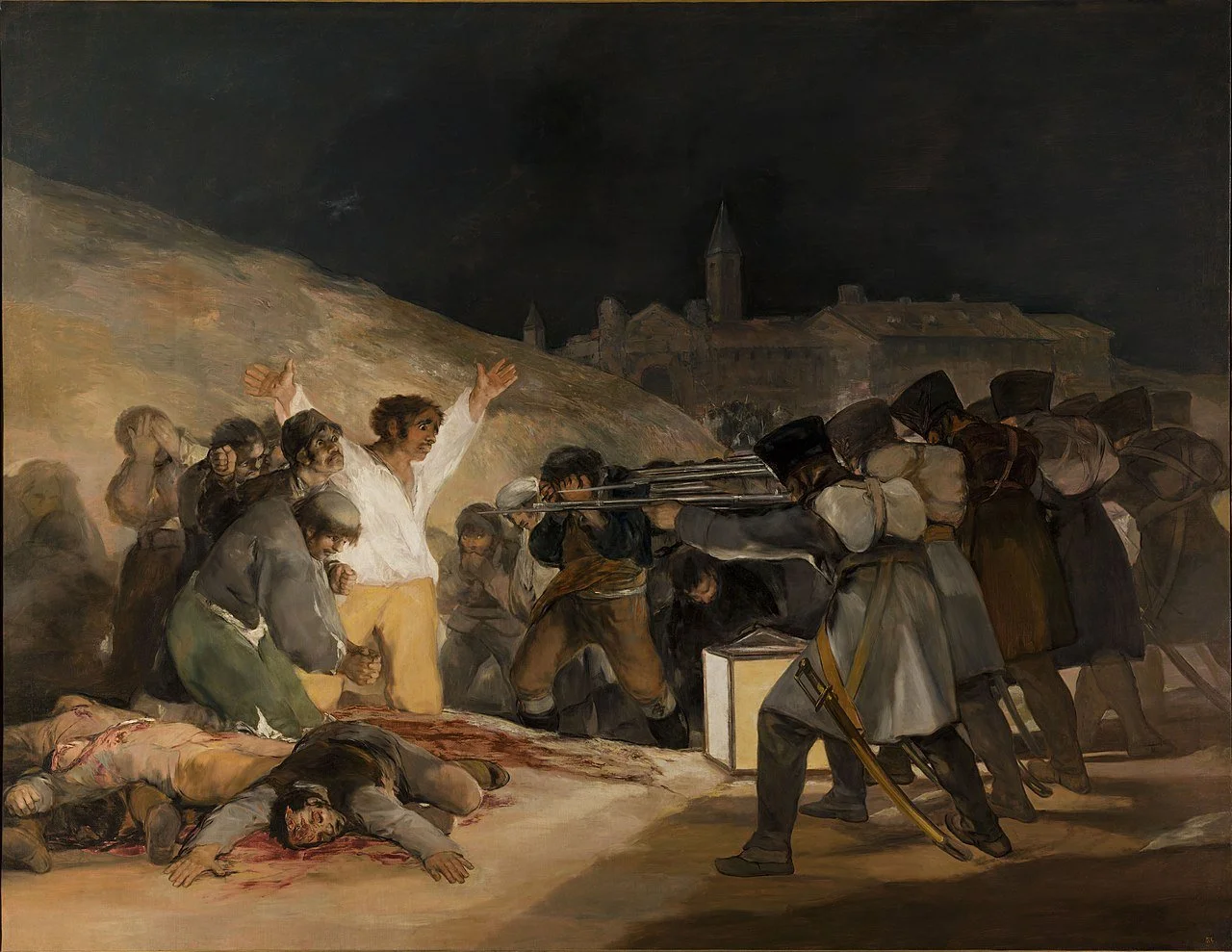
Goya (Francisco de Goya y Lucientes) 1814 Oil on canva 268 cm x 347 cm (106 in × 137 in)
“The Third of May 1808” is an oil painting on the hill of the Príncipe Pío, where the French army executed Spanish patriots in retaliation for their uprising against the occupation the previous day. Goya portrays the tension and fear in the moments immediately prior to the execution of an ordinary man. A pile of dead bodies lies at his feet, streaming blood. To his other side, a line of Spanish rebels stretches endlessly into the landscape. They cover their eyes to avoid watching the death that they know awaits them. Goya witnessed these events firsthand and was able to convey his trauma into the emotions of the characters who were being slaughtered like animals. Goya was also deaf at this point of his life which conveys the silence and stillness of this painting with no active motion or chaos, but still brings the sense of murder and grief.
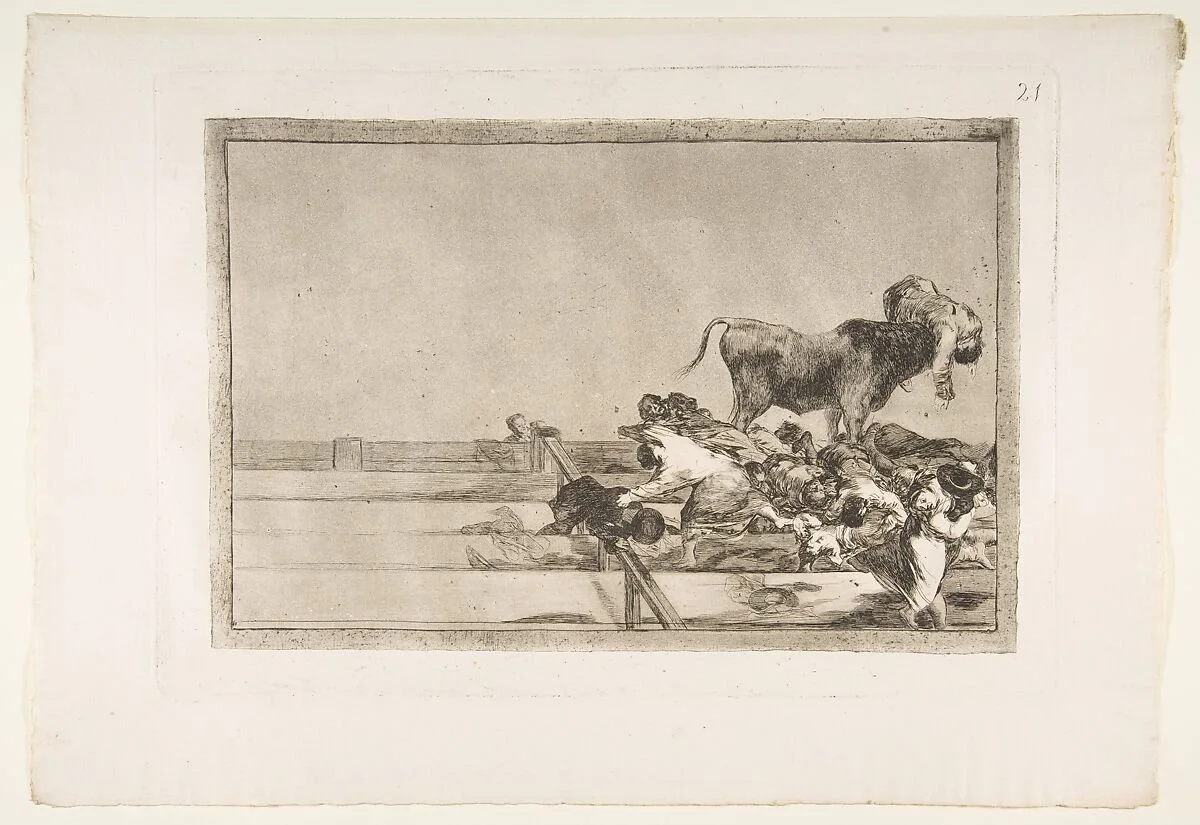
Goya (Francisco de Goya y Lucientes) . Plate 21 from "La Tauromaquia": Dreadful events in the front rows of the ring at Madrid and death of the mayor of Torrejon Prints Plate: 9 11/16 × 13 7/8 in. (24.6 × 35.2 cm) Sheet: 12 1/8 × 17 1/4 in. (30.8 × 43.8 cm)
La Tauromaquia:“Dreadful events in the front rows of the ring at Madrid and death of the mayor of Torrejon” is the most extraordinary bullfighting episode that Goya might have witnessed. It depicted the death by goring of the mayor of Torrejón in the bullring at Madrid. The mayor of Torrejon’s dead body is hanging off the bulls head from the impact with blood dripping from his body. The stampeding front row spectators reveal a collective trauma. Goya is recording an actual event, but in this graphic image he is simultaneously honoring the larger truth that we must not let sentimentality underestimate the presence of danger. Instinct and chaos are just a few rows away. The distant figure watching in the background resembles Goya. This bystander’s attentive yet detached expression, compared with the other figures’ looks of horror, might allude to the creative distance that separates artist from subject.
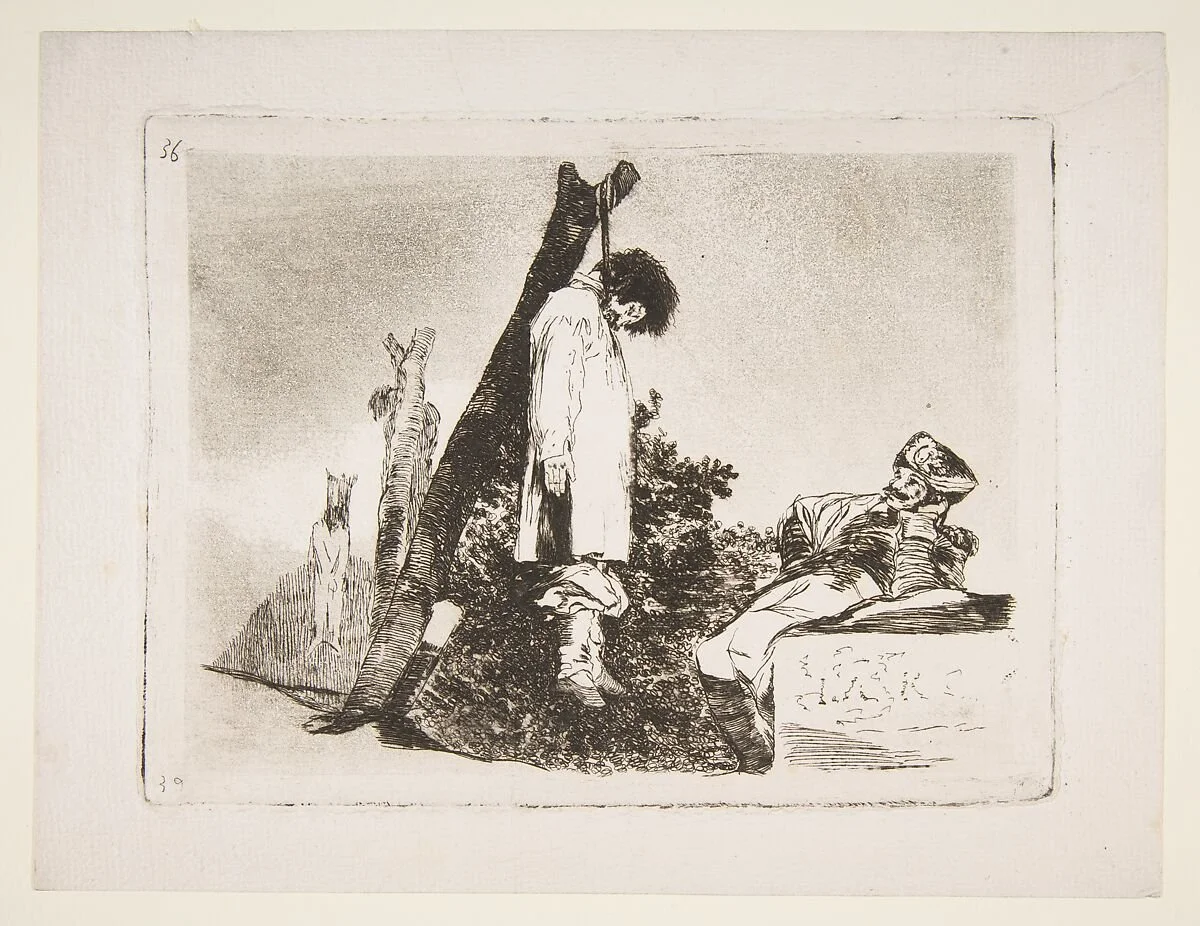
Goya (Francisco de Goya y Lucientes) Spanish 1810 Not [in this case] either (Tampoco), plate 36 from "The Disasters of War" (Los Desastres de La Guerra) Prints Plate: 6 in. × 8 1/16 in. (15.3 × 20.4 cm) Sheet: 8 in. × 9 15/16 in. (20.3 × 25.2 cm)
“The Disasters of Wars” is a 80 etching and aquatint series displaying the horrors that were happening during the Napoleon Bonaparte regime. Napoleon wanted to look for more areas in which he could expand his empire so he sent out French troops to acquire more land when they reached Madrid, Spanish civilians fought back. After five years of French occupation, Goya in his response to the trauma witnessing this war, created the disaster of war series. He wanted to put a clear message out about how war turned both sides into monsters. These etching displayed chilling images of death, fighting, and suffering. This piece called “Not in this case” displays hanging bodies that go off to the horizon with the body in the forefront with his pants around his ankles, most likely his own belt was used to hang him. The French soldier smirks at the dead body in a relaxing pose, as if taking pleasure in viewing the dead man hanging from the tree. These 80 prints were locked away and were not published until 30 years after his step which begs the question: should we be seeing these?
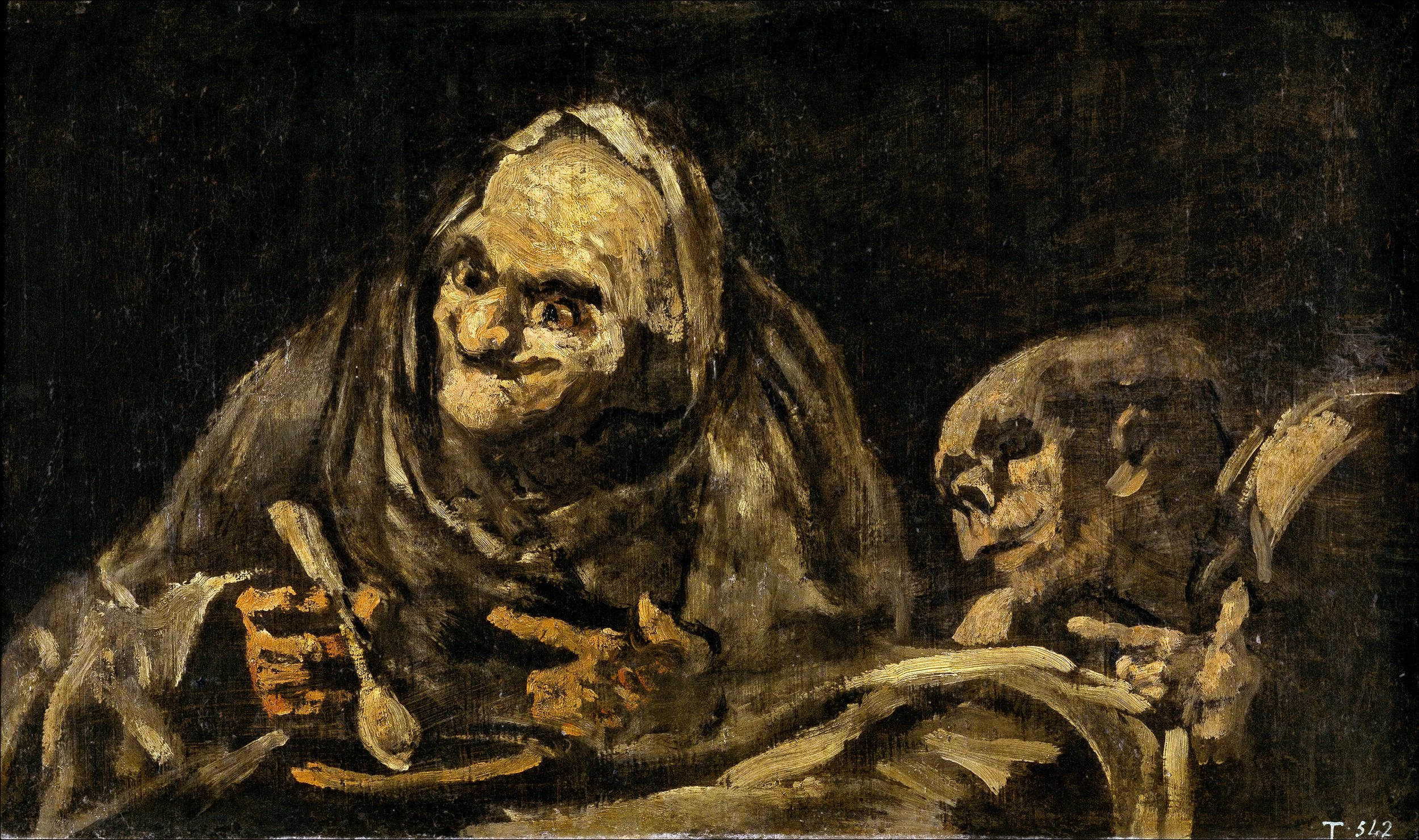
Goya (Francisco de Goya y Lucientes) 1819-1823 Oil mural transferred to canvas 49.3 cm × 83.4 cm (19.4 in × 32.8 in)
“Two Old Ones Eating Soup” is one out of the 14 paintings in Goya’s black painting series, which was created from 1819-1823. This painting displays two older figures eating soup, one figure seemingly is an older woman, creepily smiling, while gazing off to the left. While the figure on the right seems like a corpse with hollow eyes. No expression, shrouded in shadows and almost skeleton-like. By the time this was painted, Goya had moved to a secluded villa in Madrid, Spain. He was suffering from hallucinations, deafness, and other illnesses. He was in his late 70s by the time he painted this, which evoked themes of decay and old age, the feeling of lingering death. This painting also seems to be a comment on starvation in Spain. Questioning mortality, of himself and society. This idea that nothing lasts forever and suffering is inevitable, which Goya was extremely terrified of.

My name is Olivia. I study art history. While studying at Temple, I studied many different art periods. My interest in cultural art, art created by minorities and artists' lives. I am also an artist myself which has helped me explore our history through not just a historic lens, but a visual lens which has brought in my knowledge not only on historical context, but art making context. I love talking about art and art history, drawing, and collect house plants.