

The Triumphal Arch of Maximilian I: Defining A Holy and Roman Empire
Jay DaCruz | Art History 2027
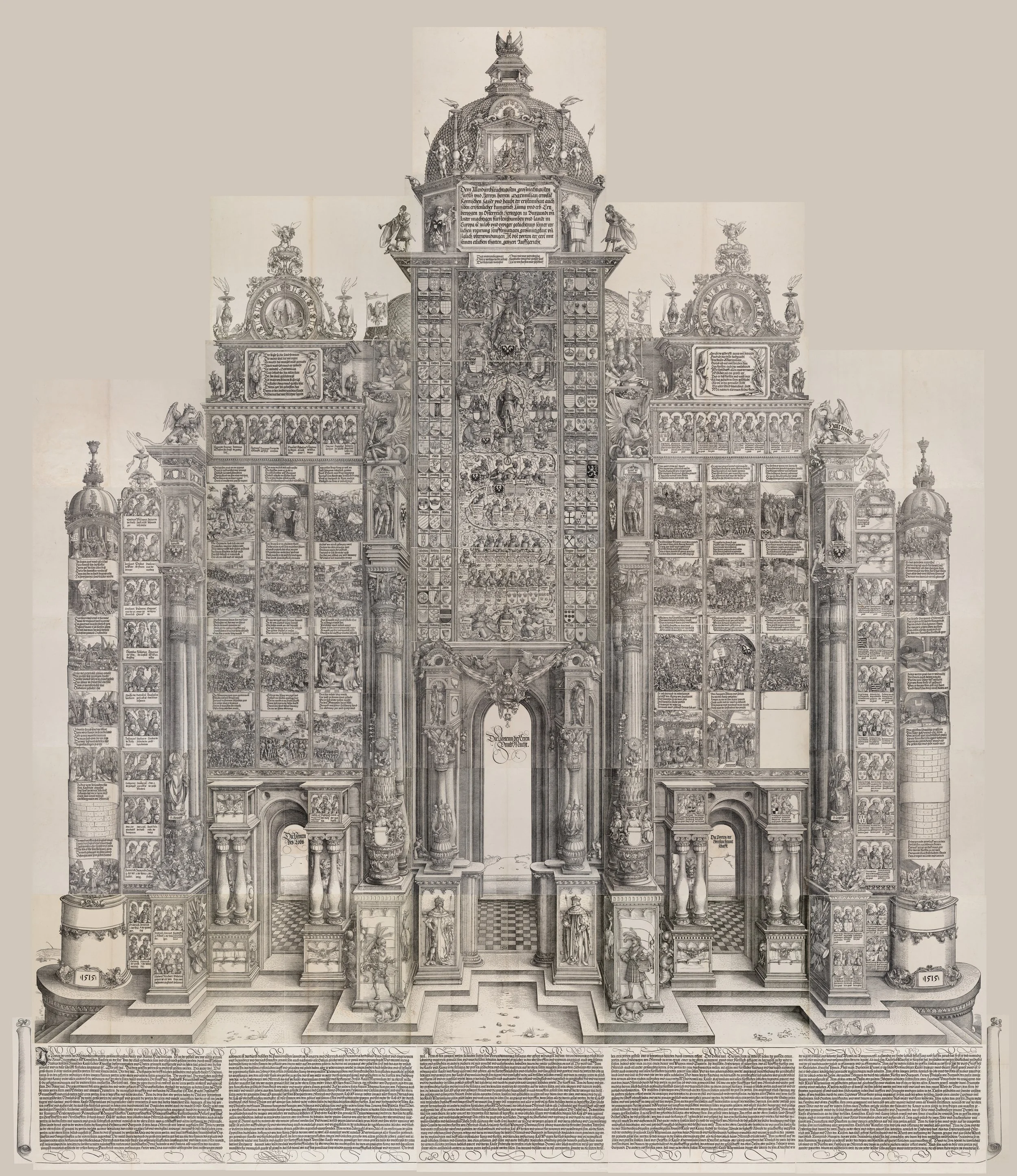
Albrecht Dürer, Albrecht Altdorfer, Hans Springinklee, Wolf Traut, Triumphal Arch of Maximilian I, 1515, woodcut
The Triumphal Arch of Maximilian I is a defining work of imperial propaganda. The overwhelmingly complex program of images that ornament the printed architectural form of the arch, work together to legitimize its patron Maximilian I (1459-1519) as worthy of his role as emperor. Holy Roman Emperor Maximilian I’s profound patronage of art was forced to navigate the evolving identity of the empire he ruled. He commissioned many works throughout his life that would be used to define the visual rhetoric of the empire but it is his Triumphal Arch on paper that stands out as one piece of imperial propaganda that uniquely captures all of the constructed elements key to Maximilian I’s title of Holy Roman Emperor. It is with this monumental print that Maximilian I simultaneously identifies himself as a modern christian German emperor who is also the continuation of Ancient Rome.
This print is composed of over 195 individual wood blocks that would be printed onto 36 sheets of paper that come together to form one oversized composite image. When compiled into its final form it measures over 12 feet tall and 9 feet wide. Completed in 1515 this ambitious print pushed the limitations of what this relatively new medium for the Holy Roman Empire could do. Maximilian I's significant investment into what his European contemporaries thought of as the distinctly German medium of print was not accidental. It coincided with Maximilian I’s founding of the first official postal system in Europe which uniquely prepared him to spread this medium of multiples. Given as gifts to rivals and friends in cities near and far Maximilian insured that his presence would be felt on whatever walls this print adorned.
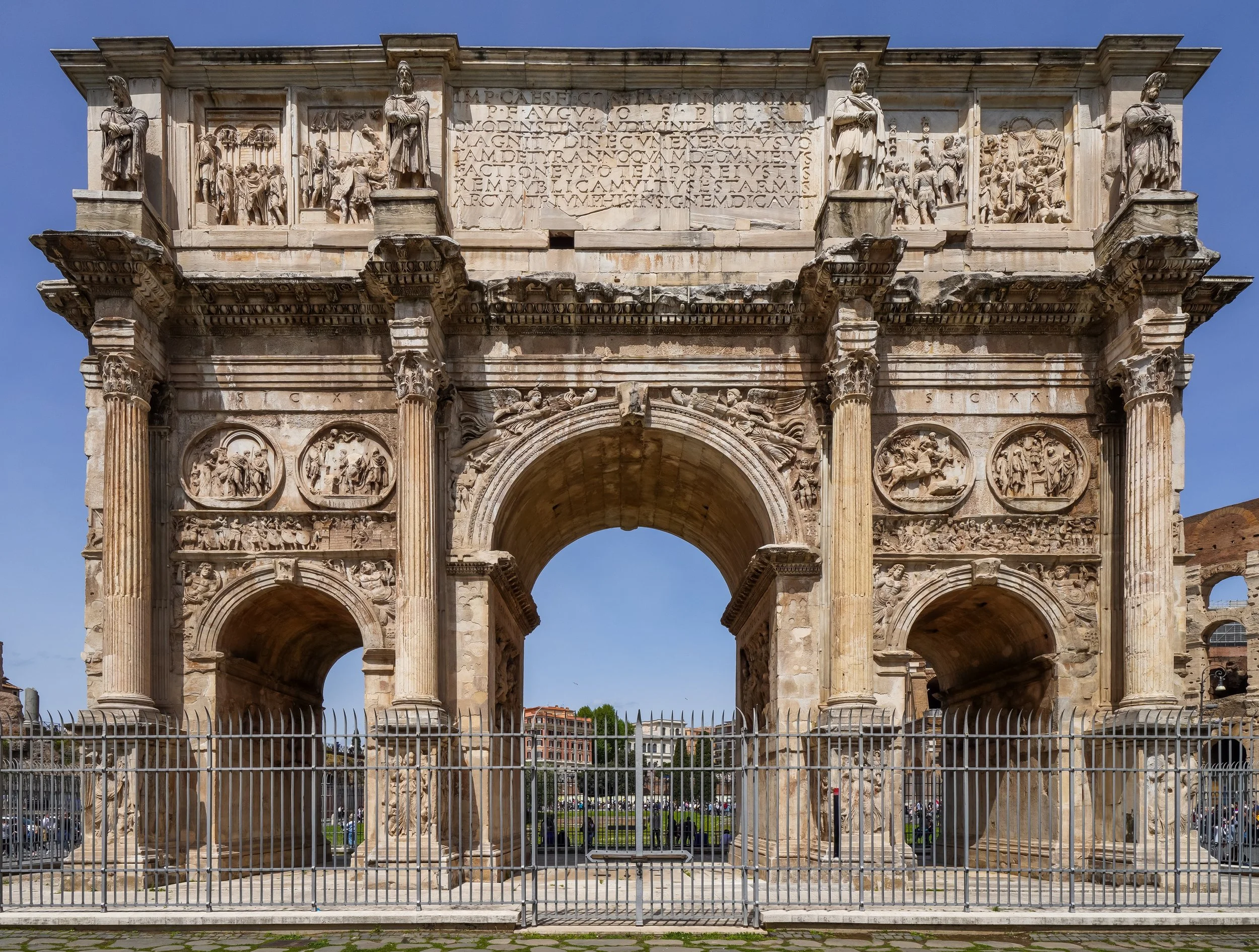
Unknown Artists, Arch of Constantine, 315, Brick-faced Concrete with Marble exterior
The primary thing that Maximilian is trying to replicate and his biggest influence is that of the triumphal arches made by Ancient Roman emperors. This is clearly stated in the inscription on the bottom of Maximilian's arch where he claims to be continuing in the tradition of his ancient predecessor by constructing a triumphal arch. This is the Arch of Constantine made in 315 CE. As was tradition Constantine's triumphal arch was an architectural monument physically made of concrete, brick, marble to remember a triumph. A roman triumph was a celebration typically for victory in a war, or the success of a particularly important siege or battle. Constantine’s arch is decorated using a common practice in the ancient Mediterranean called spoliation, in this case it is the stolen parts of previous triumphal arches implanted in the facade of Constantine's arch. These spoliated elements are taken from three emperors, Hadrian, Trajan, and Marcus Aurelius that were considered to be good emperors. Constantine uses these elements to legitimize himself and to claim that he is like these three good emperors.
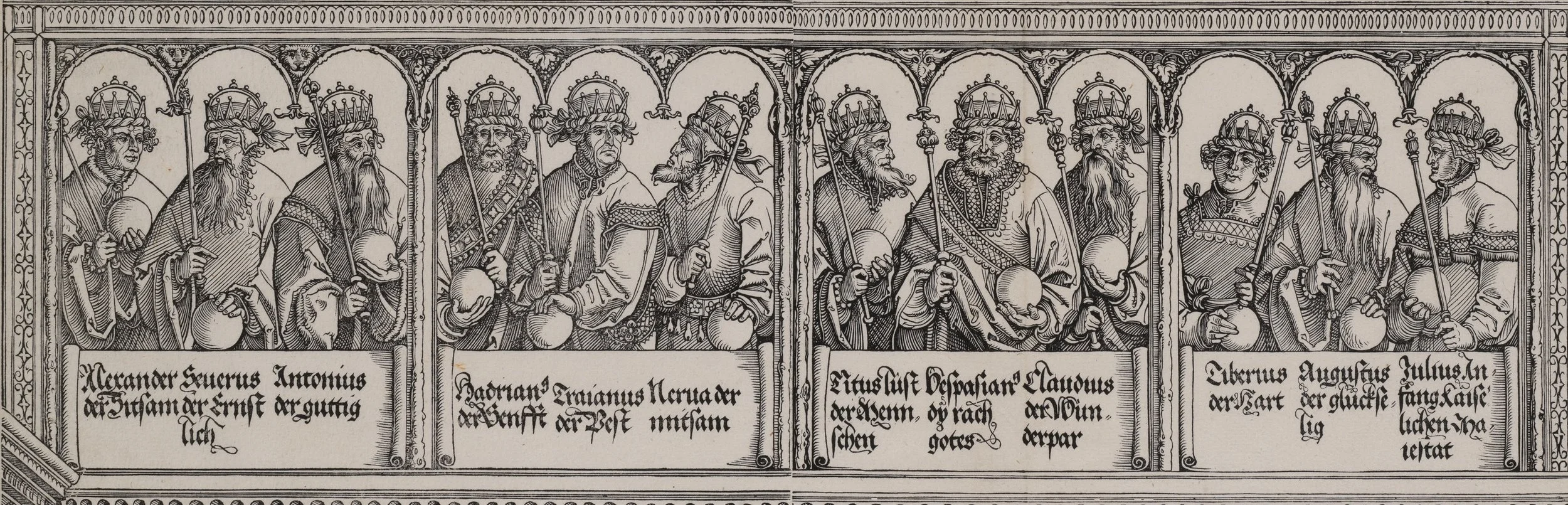
Various Artists, detail from: Triumphal Arch of Maximilian I, 1515, woodcut
For many, making a triumphal arch in itself would be enough to prove a connection to Rome. This was not the case for Maximilian however, he in pursuing his deep interest in his own family genealogy and in tracing the history of his imperial crown acted as a sort of historian. The detail showing a row of emperors is taken from the top left tower of Maximilian's Triumphal Arch, that claims to be identifying the ranks of great rulers who Maximilian is on par with that once held his position as emperor. Some of the emperors shown in this image are familiar such as Hadrian, Trajan, and Julius Caesar. Although Maximilian’s printed Arch does not look like that of the arches from Ancient Rome his is maintaining the practice of legitimizing one's rule through referencing previous emperors that is seen in the Arch of Constantine’s spolia.
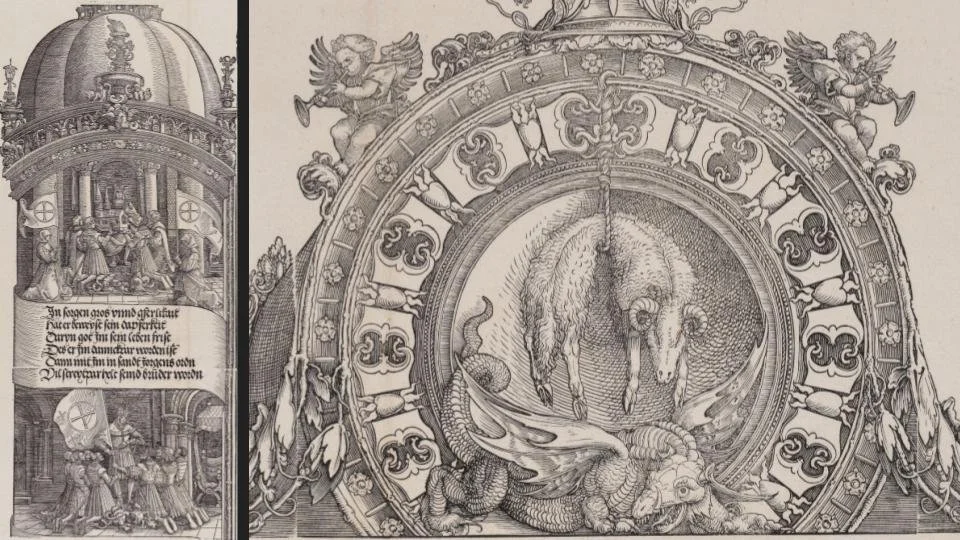
Various Artists, detail from: Triumphal Arch of Maximilian I, 1515, woodcut
These are two of many details that are intended to show the key aspect of Maximilian's role as Holy Roman Emperor that distinguishes him from his Roman Emperor predecessors. This is that he is Christian. Each of these details shows a chivalric order that Maximilian was closely associated with. The sheep skin hung from and encircled by a chain represents the insignia of the Order of the Golden Fleece. Which was a group of knights founded by Maximilian's grandfather-in-law with the intention of uniting the various leaders of Christendom. The two smaller panels show Maximilian's patronage and strengthening of the Order of Saint George, a group of knights formed to protect the Holy Roman Empire and Christendom at large from the impending threat of the Ottoman Empire. Which was thought of as a threat to Christianity at large. Maximilian is identifying himself as the Christian leader to rally behind to “protect Christendom” in many ways the Arch serves as a call to arms.
Various Artists, detail from: Triumphal Arch of Maximilian I, 1515, woodcut
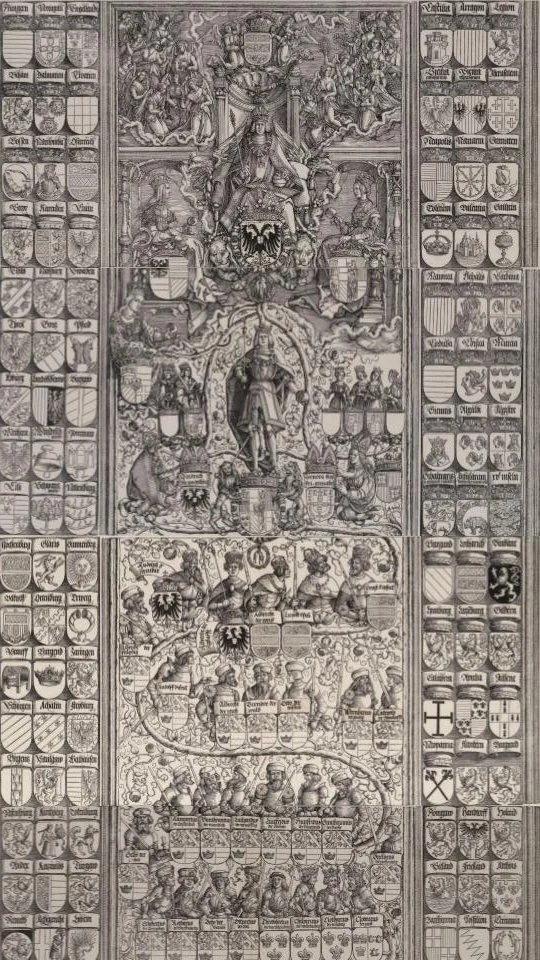
Maximilian’s Genealogy takes up the central tower and is the single largest detail within the arch. On either side of the arch are heraldic shields denoting all of the lands that Maximilian claims. While Maximilian was only semi successful in his military conquests, he did manage to expand the Holy Roman Empire significantly. He did this largely through strategic marriages. This genealogy is not only a way to show Maximilian legitimacy, but it's a way to show Maximilian's heirs legitimacy and the Habsburg family at large. While this genealogy was certainly presented as fact, many of the people Maximilian claims relation to were not his real ancestors. The first and furthest back person that appears on this Habsburg genealogy is Clovis who as the first Christian king in Maximilian dynasty is the prototype for those who follow. This genealogy also legitimizes Maximilian by showing him as having ancient German roots going further back then Rome with his personified Trojan who supposedly settled in Germany similar to the story of Aeneas founding Rome.
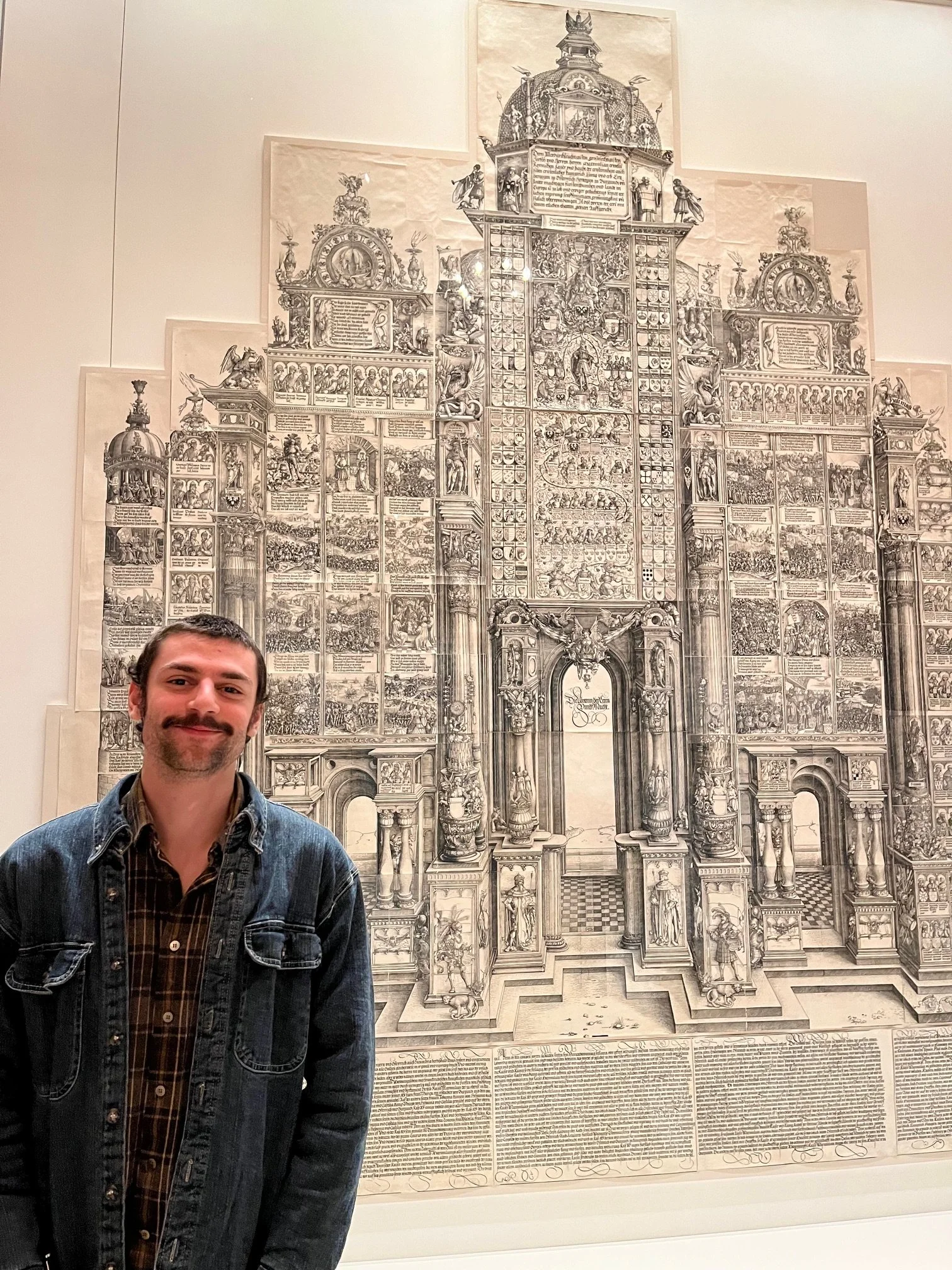
Jay DaCruz is a junior art history major with a minor in philosophy at Temple University's Tyler School of Art and Architecture. His recent research interests include propaganda, print culture and monuments especially in early modern Europe.
Instagram: @jay.dacruz